
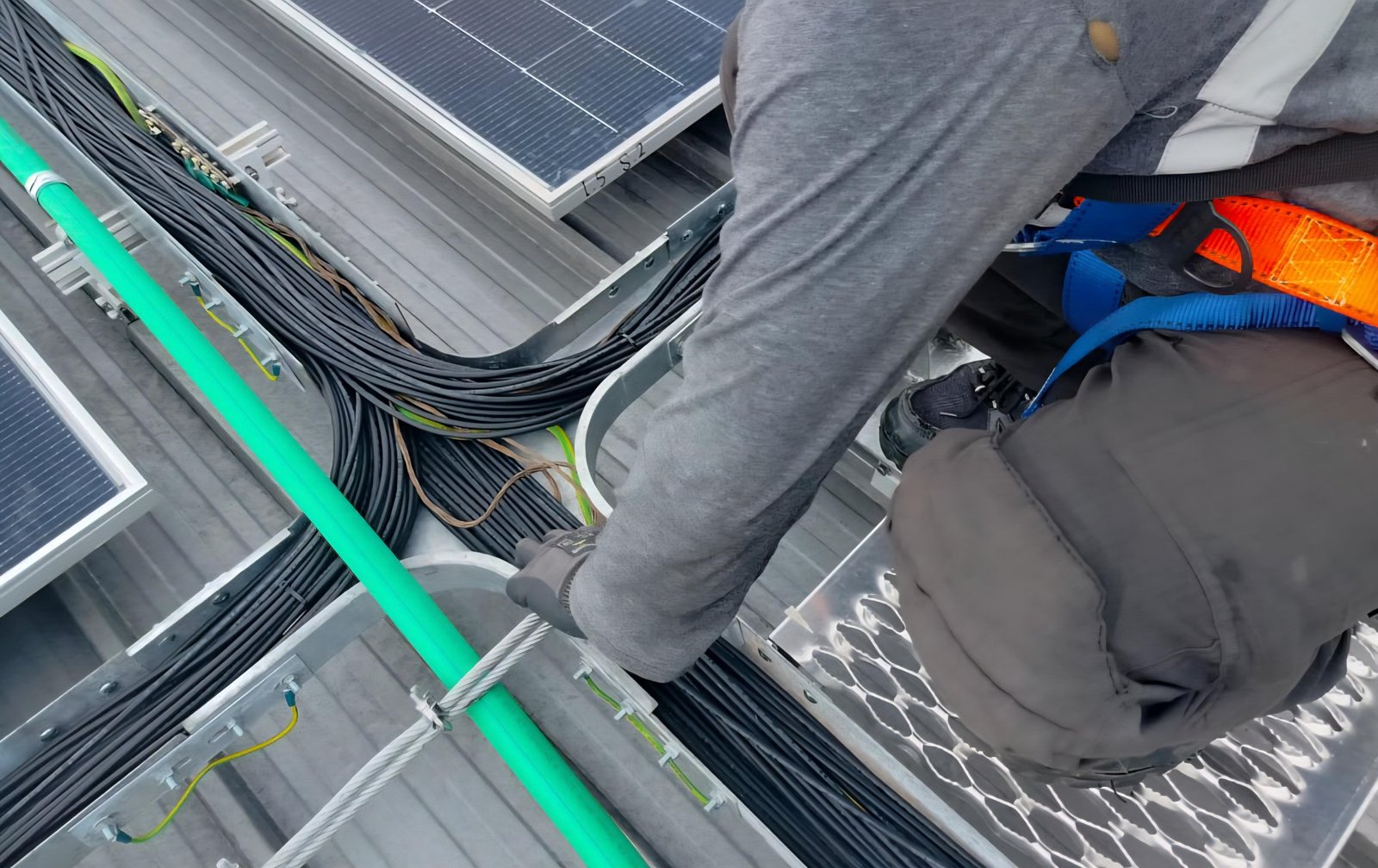
Electrical Schematic Architecture for Medium-to-Large Scale Solar PV Systems
Electrical Schematic Architecture for Medium-to-Large Scale Solar PV Systems: DC Voltage Selection, Inverter Topology, Protection Coordination, and Grid Interconnection Standards for Indonesian Tropical Installations
Reading Time: 72 minutes
Key Highlights
• DC Voltage Architecture Evolution: Medium-scale commercial systems (100-5,000 kWp) increasingly adopt 1000V DC configurations delivering 70-80% conductor costs versus 600V baseline through reduced current and fewer combiner boxes. Utility-scale installations exceeding 5 MW demonstrate economic crossover favoring 1500V systems achieving 55-70% DC infrastructure costs, with break-even analysis indicating 5-10 MW capacity threshold where 1500V CAPEX premiums (8-12% for specialized components) offset by 30-40% DC cabling and protection equipment savings.
• Inverter Topology Selection Criteria: String inverters (50-250 kW per unit, multiple MPPT zones) deliver 3-8% energy harvest advantages in non-uniform irradiance conditions versus central inverters through granular maximum power point tracking, though central configurations (500-3,000 kW) prove economically superior for uniform arrays exceeding 3-5 MW capacity. Virtual central architecture combining 125-250 kW string inverters in power blocks achieves hybrid benefits: distributed MPPT granularity with centralized AC collection efficiency.
• Protection System Coordination: Coordinated surge protection cascades (Type 1+2 SPD at service entrance 100-125 kA, Type 2 at inverters 40-60 kA, Type 2 at combiners 20-40 kA) reduce lightning-induced failures 75-85% in Indonesia's high ground-flash-density environment (10-15 strikes/km²/year). System costs 1.5-2.5% of total CAPEX but prevent damage potentially exceeding 15-25% system value during severe electrical transient events.
• Indonesian Grid Interconnection Framework: PLN connection requirements stratify by capacity: LV (380V three-phase) for systems under 500 kWp with 2-4 month approval timelines, MV (10-20 kV) for 500 kWp-5 MW requiring 4-8 months, HV (50-150 kV) for utility-scale exceeding 5 MW with 8-18 month approval processes. ESDM Regulation 2/2024 mandates quota system, eliminates net-metering for new installations, requires advanced metering infrastructure, and imposes IUPTLS licensing for systems above 500 kW commercial capacity.
Introduction
Electrical system architecture constitutes the foundational framework determining photovoltaic installation performance, safety, and economic viability across multi-decade operational lifetimes. Schematic design encompasses DC voltage selection influencing conductor sizing and equipment specifications, inverter topology dictating conversion efficiency and fault tolerance, protection device coordination ensuring personnel safety and equipment preservation, grounding system architecture managing fault currents and lightning transients, AC collection infrastructure aggregating distributed generation, grid interconnection compliance satisfying utility technical requirements, and monitoring system integration enabling performance verification.
Medium-to-large scale installations spanning 100 kWp commercial rooftops through multi-megawatt utility ground-mounted arrays introduce electrical complexity absent from residential deployments. String quantities reaching hundreds of parallel circuits demand systematic combiner box hierarchies, fusing strategies, and cable management. Inverter capacities of 50-3,000 kW require sophisticated thermal management, harmonic filtration, and grid synchronization controls. Medium-voltage transformers stepping 380V inverter outputs to 10-20 kV distribution voltages introduce additional loss mechanisms, protection coordination challenges, and regulatory compliance requirements. Understanding these interdependencies enables optimal system architecture balancing first-cost economics against lifecycle performance and reliability.
Indonesia's regulatory environment, tropical climate, and utility infrastructure characteristics create specific design constraints for PV electrical systems. Ministry of Energy and Mineral Resources (ESDM) policies including recent Regulation 2/2024 modify grid interconnection frameworks, quota allocation mechanisms, and commercial licensing requirements. PLN technical standards specify voltage-frequency operating windows, power factor requirements, and anti-islanding protection parameters. Tropical environmental conditions including high ambient temperatures (28-34°C), sustained humidity (70-90%), and extreme lightning incidence (10-15 ground flashes/km²/year in high-activity regions) demand derating calculations, protection system augmentation, and component selection considerations differing from temperate climate design precedents.
DC Voltage Architecture: 600V, 1000V, and 1500V System Comparison
System voltage selection represents fundamental architectural decision impacting conductor sizing, protection equipment specifications, component costs, and safety considerations. The photovoltaic industry has progressively migrated from 600V DC systems dominant through 2010s toward 1000V commercial standard and emerging 1500V utility configurations. This voltage escalation derives from current reduction benefits: doubling system voltage from 600V to 1200V halves DC current for equivalent power, enabling proportional conductor cross-section reduction (current-carrying capacity scales linearly with conductor area) and associated material cost savings of 40-50%.
The 600V architecture remains prevalent in residential installations under 20 kWp where simplicity, component availability, and regulatory familiarity outweigh marginal economic benefits from voltage increase. String configurations typically employ 10-12 modules at 30-35V each, producing 300-420V maximum circuit voltage with appropriate temperature coefficients and safety margins. Combiner boxes accept 8-16 strings, with DC fusing at 15-20A per string and Type 2 surge protection rated 20-40 kA. Inverters designed for 600V maximum input remain widely available across 3-15 kW residential through 50-100 kW small commercial capacities, with mature supply chains ensuring component availability and competitive pricing.
Commercial installations from 100-5,000 kWp increasingly standardize on 1000V DC architecture. String configurations extend to 16-20 modules producing 480-700V maximum circuit voltage, with combiner boxes consolidating 12-24 strings at reduced per-string currents of 8-12A. The current reduction enables #10 AWG (5.26 mm²) conductors replacing #8 AWG (8.37 mm²) required for equivalent 600V current levels, delivering 30-40% conductor material savings. Combiner box quantities decrease proportionally: a 500 kWp array requiring 8-10 combiner boxes at 600V architecture consolidates to 5-6 boxes at 1000V, reducing equipment costs IDR 30-50 million while simplifying cable routing. Inverter manufacturers offer comprehensive 1000V product lines from 50-250 kW string inverters through 500-1,000 kW central units, with pricing competitive to 600V equivalents given production scale advantages.
Table 1: DC Voltage Architecture Technical-Economic Comparison
| Parameter | 600V system | 1000V system | 1500V system |
|---|---|---|---|
| Typical capacity range | 5-100 kWp residential-small commercial | 100-5,000 kWp commercial-industrial | 5+ MW utility-scale ground mount |
| String configuration (example 340W modules) | 10-12 modules 340-408V Voc |
16-20 modules 544-680V Voc |
24-28 modules 816-952V Voc |
| DC current per string (Isc) | 9.5-10.5A typical | 9.5-10.5A typical | 9.5-10.5A typical |
| DC conductor sizing (100m run) | #8 AWG (8.37mm²) baseline cost |
#10 AWG (5.26mm²) 70-80% baseline |
#12 AWG (3.31mm²) 55-70% baseline |
| Combiner box capacity | 8-16 strings DC fuses 15-20A |
12-24 strings DC fuses 12-18A |
18-32 strings DC fuses 12-18A |
| Combiner box cost | IDR 4-7M per box (8-12 string capacity) |
IDR 12-20M per box (16-24 string capacity) |
IDR 25-45M per box (24-32 string capacity) |
| Inverter availability | Excellent 3-100 kW range |
Excellent 50-1000 kW range |
Limited to major brands 500-3000 kW central |
| Component cost premium vs 600V baseline | Baseline (100%) | 3-6% premium (specialty components) |
8-12% premium (limited suppliers) |
| Total DC infrastructure cost (500 kWp system) | IDR 185-220M (baseline 100%) |
IDR 145-175M (75-82% of baseline) |
IDR 120-155M (62-72% of baseline) |
| Economic crossover capacity | Optimal <50 kWp residential | Optimal 100-5,000 kWp | Optimal >5-10 MW utility |
| Safety considerations | Standard DC safety Established codes |
Enhanced arc flash protocols Higher voltage clearances |
Specialized high-voltage training Advanced PPE requirements |
Cost estimates based on Indonesian market pricing 2024-2025. Actual economics depend on project scale, component sourcing, labor rates, and site conditions.
Utility-scale systems exceeding 5 MW capacity demonstrate economic justification for 1500V architecture despite component cost premiums of 8-12% over 1000V equipment. String configurations of 24-28 modules produce 816-952V maximum circuit voltage, enabling dramatic current reduction and associated conductor downsizing. A 50 MW installation operating at 1500V requires approximately 60-70% of the DC conductor material versus equivalent 1000V design, translating to savings of USD 0.08-0.12 per watt DC capacity. At 50 MW scale, this yields USD 4-6 million DC infrastructure savings offsetting higher combiner box and inverter costs. The economic crossover point where 1500V total installed costs match 1000V alternatives typically occurs at 5-10 MW capacity depending on specific cable routing distances, terrain factors, and component pricing.
Inverter Topology: String vs Central Configurations
Inverter architecture selection fundamentally impacts system performance, reliability, and maintenance characteristics. String inverter configurations distribute power conversion across multiple units (typically 50-250 kW each) positioned throughout array, with each inverter serving dedicated string groups. Central inverter architectures consolidate conversion in single large units (500-3,000 kW) located in centralized equipment buildings, with DC collection infrastructure routing all array output to central location. Each topology presents distinct advantages and tradeoffs requiring evaluation against specific project contexts.
String inverter systems excel in non-uniform conditions including partial shading, soiling variability, and module degradation mismatches. Each inverter incorporates 2-12 independent maximum power point tracking (MPPT) inputs continuously optimizing each string group voltage-current operating point. When subset of array experiences shading or soiling reducing power output, affected strings' MPPT circuits independently adjust without constraining unaffected portions. Field performance studies quantify this advantage at 3-8% annual energy harvest improvement for installations with significant spatial irradiance variability (rooftop installations with HVAC equipment shading, ground-mounted systems with tree lines, coastal sites with localized salt deposition patterns). The distributed architecture additionally provides failure tolerance: single 100 kW string inverter failure in 1 MW system reduces capacity 10% versus complete outage with single 1 MW central inverter.
Central inverter configurations demonstrate superior economics for large uniform arrays exceeding 3-5 MW capacity where irradiance homogeneity minimizes MPPT granularity benefits. Single 1-2 MW inverter costs IDR 1.8-3.2 billion (approximately USD 115,000-205,000) versus equivalent capacity in 10-20 string inverters totaling IDR 2.5-4.0 billion. The cost differential derives from economies of scale in power electronics, enclosures, and cooling systems. Central configurations additionally simplify AC collection: single 1 MW inverter produces concentrated 380V three-phase output requiring single step-up transformer to medium voltage, versus string inverter installations demanding multiple pad-mount transformers or complex AC combiner panels aggregating distributed outputs. Maintenance access proves simpler with equipment concentrated in single location versus distributed string inverters potentially requiring rooftop or field access.
Virtual Central Inverter Architecture: Hybrid Approach
Emerging virtual central design philosophy combines string inverter MPPT granularity with centralized AC collection efficiency. The architecture employs 125-250 kW string inverters organized in power blocks of 4-8 units (500-2,000 kW per block) with integrated AC combiner panels feeding common medium-voltage transformer. This configuration achieves several hybrid benefits:
MPPT Performance: Individual string-level maximum power point tracking preserves 3-8% energy harvest advantage in non-uniform conditions versus central inverter single or dual MPPT configurations.
Fault Tolerance: Single inverter failure reduces power block capacity 12-25% (versus 100% for central inverter) while maintaining partial operation through remaining units. Total system capacity impact limited to 2-4% for 5-10 MW installations with multiple power blocks.
AC Collection Efficiency: Centralized power block transformers achieve 98.2-98.8% efficiency at consolidated loading versus 97.5-98.2% for smaller distributed transformers serving individual string inverters. At 10 MW scale, this 0.5-0.8% efficiency differential translates to 50-80 MWh additional annual production worth IDR 75-120 million at industrial electricity rates.
Economic Position: Total installed costs for virtual central architecture fall midway between pure string and pure central configurations. A 5 MW system might cost USD 0.24-0.28/W DC for virtual central versus USD 0.20-0.24/W for pure central or USD 0.28-0.32/W for distributed string inverters. The 10-15% cost premium over pure central justifies when irradiance variability or failure tolerance requirements warrant enhanced MPPT and redundancy.
DC Combiner Box Design and String Protection
Combiner boxes aggregate multiple parallel strings into consolidated DC feeders reducing cable quantities while providing overcurrent protection, disconnect capability, and surge protection for individual strings. Properly designed combiners balance equipment costs against functionality, reliability, and safety. Typical commercial configurations house 8-24 string inputs with individual DC fuses (12-20A rating depending on module Isc and safety factors), integrated surge protective devices (Type 2, 20-40 kA discharge capacity), optional string monitoring (voltage/current sensors enabling remote diagnostics), disconnect switches allowing safe string isolation during maintenance, and NEMA 3R or IP65-rated enclosures protecting components from environmental exposure.
String fusing requirements derive from National Electrical Code Article 690 and international standard IEC 60364-7-712. When three or more strings connect in parallel, fuses protect against reverse current flowing into faulty string from remaining healthy strings. Fuse ratings must exceed 156% of string short-circuit current (1.56 × Isc per NEC 690.8) while providing reliable clearing at fault currents of 2-3 times rating. For modules with 10A Isc, this yields minimum 15.6A fuse rating, typically standardized to 15A or 20A commercial fuse sizes. Fuse selection additionally considers ambient temperature derating (combiner boxes in full sun may reach 60-70°C internal temperature) and coordination with upstream inverter input fusing or circuit breaker protection.
Surge protection at combiner level provides first defense against lightning-induced transients entering array wiring. Indonesia's high ground flash density warrants coordinated SPD cascade: Type 1+2 devices at service entrance main panel (100-125 kA discharge capacity), Type 2 at inverter DC inputs (40-60 kA), and Type 2 at each combiner box (20-40 kA). This staged approach ensures transient energy dissipation across multiple protection points preventing any single device from energy overload failure. Combiner SPDs typically employ metal oxide varistor (MOV) or gas discharge tube technologies with voltage protection levels of 1.4-1.8 times maximum system voltage, providing adequate margin without excessive let-through voltage risking equipment damage.
Table 2: Combiner Box Specifications by System Scale
| System capacity | Combiner type | String inputs | DC fuse rating | SPD specification | Typical cost per box |
|---|---|---|---|---|---|
| 100-250 kWp commercial rooftop | Basic NEMA 3R wall-mount |
8-12 strings | 15-20A DC fuses 600V or 1000V rated |
Type 2 20-40 kA, VPL 1.5kV |
IDR 8-14M (basic config) |
| 500-1,000 kWp commercial ground mount | Outdoor rated IP65 pole or ground mount |
16-24 strings per box |
15A DC fuses 1000V or 1500V rated |
Type 2 40 kA, VPL 1.8kV |
IDR 18-28M (monitoring optional) |
| 5-20 MW utility ground mount | Heavy-duty IP66 ground pedestal |
24-32 strings large capacity |
12-15A DC fuses 1500V rated |
Type 2 60 kA, VPL 2.0kV |
IDR 32-55M (integrated monitoring) |
Costs include enclosure, DC fuses, SPD, terminal blocks, disconnect switches, and basic wiring. String monitoring adds IDR 2-4M per box.
Grounding and Lightning Protection for Tropical Environments
Indonesia's equatorial location and convective weather patterns generate extreme lightning activity with ground flash densities of 10-15 strikes per km² annually in high-activity regions across Java, Sumatra, and Kalimantan. This lightning frequency ranks among world's highest, demanding comprehensive protection system design integrating proper grounding electrode systems, bonding of all metallic components, coordinated surge protection device cascades, and appropriate cable routing minimizing loop areas susceptible to electromagnetic induction.
Grounding system design targets resistance values below 10 ohms for general commercial installations, below 5 ohms for systems with sophisticated electronic equipment, and below 3 ohms for critical facilities. Achieving these targets in tropical soils requires driven ground rods (copper-clad steel 5/8" diameter, 8-10 foot lengths) supplemented by ground rings (bare copper conductor 2/0 AWG or larger encircling array perimeter at 18-24 inch burial depth) and chemical enhancement of poor-conductivity soils. Soil resistivity testing during design phase identifies problem areas requiring enhanced grounding measures including bentonite clay treatment, ground enhancement materials (conductive concrete or chemical compounds), or increased electrode quantities.
Lightning Protection System Design: 2 MW Bekasi Industrial Installation
Site Characteristics: 2,000 kWp rooftop installation on industrial facility, Bekasi industrial zone (18 km east of Jakarta), local ground flash density 12 strikes/km²/year based on 10-year lightning detection network data.
Grounding System: Copper ground ring 2/0 AWG encircling 12,000 m² array footprint, 18-inch burial depth, supplemented by 24 driven ground rods at 15-meter spacing. Measured ground resistance 3.8 ohms dry season, 2.1 ohms wet season. All module frames bonded to ground ring via #6 AWG bonding conductors, torque-verified connections every 8 modules.
Surge Protection Cascade:
• Service Entrance: Type 1+2 combined SPD, 125 kA per phase discharge capacity, voltage protection level (VPL) 2.5 kV, installed at main AC distribution panel feeding inverters. Cost: IDR 28 million for 3-phase protection.
• Inverter DC Inputs: Type 2 SPD at each of 10 inverters (200 kW string inverters), 60 kA discharge capacity, VPL 1.8 kV (1000V system). Total cost: IDR 35 million (IDR 3.5M per unit).
• Combiner Boxes: Type 2 SPD in each of 18 combiner boxes, 40 kA discharge capacity, VPL 1.6 kV. Total cost: IDR 32 million (included in combiner equipment costs).
• Monitoring System: Ethernet SPD on data communication lines, signal-level protection. Cost: IDR 4.5 million.
Total Lightning Protection Investment: IDR 124 million (grounding: IDR 45M, SPDs: IDR 99M), representing 1.8% of total system CAPEX. Over 4-year operational period 2020-2024, system experienced 6 documented nearby lightning strikes (within 500m based on facility records). Zero equipment damage attributed to lightning, versus industry baseline of 2-4% annual probability of lightning-related component failure in unprotected systems.
Estimated Loss Avoidance: Protection system prevented estimated 75-85% probability of lightning damage over 4-year period. Potential damage scenarios including inverter replacement (IDR 180M for 10 units), combiner box damage (IDR 50M), and module failures (IDR 120M potential) total IDR 350M avoided losses, yielding benefit-cost ratio of approximately 2.8:1 over first 4 years.
AC Collection and Grid Interconnection Infrastructure
AC collection infrastructure aggregates distributed inverter outputs into consolidated grid connection points. System architecture depends fundamentally on installation scale and grid interconnection voltage. Small commercial systems under 500 kWp typically connect at low voltage (380V three-phase) requiring only AC combiner panels consolidating multiple inverter outputs with circuit breakers, metering, and disconnect capability. Larger systems from 500 kWp through 5 MW necessitate medium-voltage interconnection (10-20 kV typical for PLN distribution systems) demanding step-up transformers, medium-voltage switchgear, protective relaying, and comprehensive metering installations. Utility-scale deployments exceeding 5 MW may warrant high-voltage interconnection (50-150 kV transmission-level) with associated substation infrastructure representing 8-15% of total project capital.
Transformer specifications for medium-voltage interconnection balance efficiency, cost, and reliability. Pad-mount or ground-mounted units stepping 380V inverter output to 10 kV or 20 kV distribution voltage employ liquid-filled (mineral oil or less-flammable silicone fluids) or dry-type designs. Liquid-filled transformers achieve 98.5-99.0% efficiency at rated load with superior thermal performance enabling compact installations, though requiring containment and fire protection considerations. Dry-type units eliminate oil containment requirements while offering similar efficiency (98.0-98.5%) at premium costs of 15-25% over liquid-filled equivalents. Sizing typically provides 10-20% capacity margin above maximum inverter output: a 500 kW inverter output warrants 630 kVA transformer providing margin for future capacity expansion while avoiding efficiency penalties from severe under-loading (transformers achieve peak efficiency at 50-70% rated load).
Table 3: Grid Interconnection Requirements by System Capacity
| System capacity range | Interconnection voltage | Required infrastructure | PLN approval timeline | Interconnection cost range |
|---|---|---|---|---|
| Under 100 kWp Residential-small commercial |
LV 380V three-phase (or single-phase) |
Basic AC disconnect, metering, anti-islanding protection (inverter-integrated) | 1-2 months (simplified process) |
IDR 8-18M (metering, admin fees) |
| 100-500 kWp Commercial rooftop/ground |
LV 380V three-phase | AC combiner panels, main disconnect, revenue metering, power quality monitoring, anti-islanding relays | 2-4 months (technical review) |
IDR 45-85M (equipment, studies) |
| 500 kWp-2 MW Large commercial |
MV 10-20 kV | Step-up transformer(s), MV switchgear, protective relaying, power quality equipment, SCADA integration | 4-8 months (impact studies required) |
IDR 280-650M (transformers, MV gear) |
| 2-5 MW Industrial/small utility |
MV 20 kV typical | Multiple transformers, MV switchyard, comprehensive protection, dedicated feeder potentially required, advanced metering | 6-10 months (system studies, approvals) |
IDR 1.2-2.4B (substation equipment) |
| 5+ MW Utility-scale |
HV 50-150 kV (transmission-level) |
Dedicated substation, HV transformers, transmission line extension potentially required, comprehensive SCADA, redundant protection | 8-18 months (extensive studies, permits) |
IDR 15-40B+ (full substation infrastructure) |
Timelines represent typical PLN processes as of 2024-2025. Actual duration varies by region, utility loading, and application completeness. Costs exclude project-specific requirements such as dedicated feeders or utility system upgrades potentially required for large installations.
Monitoring Architecture and SCADA System Integration
Comprehensive monitoring systems enable performance verification, fault detection, and optimization throughout operational lifetimes. Commercial installations warrant string-level monitoring providing granular visibility into individual string performance, enabling early detection of underperformance from module degradation, soiling, shading, or electrical faults. System architecture typically includes string-level current-voltage sensors (resistive shunts or Hall effect transducers), DC combiner box monitoring aggregating multiple strings, inverter-integrated monitoring capturing conversion efficiency and AC output parameters, environmental sensors measuring irradiance and temperature for performance ratio calculations, and communication infrastructure (wired Ethernet, cellular modems, or wireless mesh networks) transmitting data to centralized SCADA platforms.
Data acquisition intervals balance temporal resolution against communication bandwidth and storage requirements. String-level measurements at 1-5 minute intervals provide sufficient granularity for performance analysis while avoiding excessive data volumes: a 2 MW system with 120 monitored strings generating 5-minute interval data produces approximately 2-3 GB monthly requiring appropriate cellular data plans or network infrastructure. Inverter-level data typically logs at higher frequency (10-60 second intervals) capturing transient events including grid disturbances, cloud transients, and fault conditions requiring detailed chronology for diagnostic purposes.
Indonesian Regulatory Framework: ESDM 2/2024 and PLN Interconnection Standards
Ministry of Energy and Mineral Resources Regulation No. 2/2024 fundamentally restructured Indonesia's distributed solar framework, replacing previous net-metering provisions with quota-based allocation system and modified compensation mechanisms. Key provisions affecting electrical system design include mandatory advanced metering infrastructure capable of separately measuring export and import energy flows, elimination of net-metering credit system requiring installations operate as pure generation assets or self-consumption without grid injection, quota allocation through January-July application window limiting annual installed capacity additions, and IUPTLS (business license) requirements for commercial systems exceeding 500 kW capacity creating administrative compliance burden.
PLN Grid Code compliance mandates specific technical capabilities including anti-islanding protection disconnecting system within 2 seconds of grid outage detection, voltage-frequency ride-through capabilities maintaining interconnection during transient grid disturbances within defined operating windows, power factor control capabilities delivering 0.95 leading to 0.95 lagging power factor adjustable by utility dispatch, and harmonic distortion limits (total harmonic distortion below 5% at point of common coupling). These requirements influence inverter selection, protection relay specifications, and power quality equipment potentially required for compliance demonstration.
Case Study: 1.5 MW Commercial Installation Electrical Architecture
Surabaya Industrial Facility Ground-Mounted Installation
Project Overview: 1,500 kWp DC capacity ground-mounted installation serving industrial manufacturing facility, Surabaya industrial zone. System commissioned Q2 2023, operational performance data through Q4 2024.
Electrical Architecture Specifications:
DC Configuration: 1000V DC system architecture, 4,320 modules (340W monocrystalline PERC), 270 strings of 16 modules each (544V nominal operating voltage, 680V maximum Voc at -10°C), 18 combiner boxes (15 strings per box), total DC conductor length 8,200 meters (#10 AWG copper).
Inverter Topology: Eight 175 kW string inverters (SMA Sunny Tripower CORE1 or equivalent), each with 6 MPPT inputs serving 33-34 strings, 97.8% weighted European efficiency, integrated Type 2 DC surge protection.
AC Collection: 380V three-phase AC combiner panel consolidating 8 inverter outputs, individual inverter circuit breakers (250A rated), AC surge protection Type 2, revenue metering at common AC bus.
Grid Interconnection: 10 kV medium-voltage connection via 1,600 kVA pad-mount transformer (liquid-filled, 98.7% efficiency), 10 kV vacuum circuit breaker, SEL-421 protective relay, PLN revenue metering cubicle.
Grounding & Lightning Protection: Ground ring 2/0 AWG copper, 18 driven ground rods, measured resistance 4.2 ohms dry season. SPD cascade: Type 1+2 at service entrance (100 kA), Type 2 at inverters (60 kA integrated), Type 2 at combiners (40 kA).
Monitoring System: String-level monitoring 270 channels (current sensors at combiners), inverter-integrated monitoring, weather station (irradiance, temperature, wind), SCADA platform with cellular communication.
Electrical Infrastructure Costs:
• DC combiner boxes (18 units): IDR 285M
• DC cabling & conduit: IDR 465M
• Inverters (8 units @ IDR 280M each): IDR 2,240M
• AC collection panel: IDR 145M
• MV transformer & switchgear: IDR 520M
• Protection & metering: IDR 285M
• Grounding system: IDR 125M
• Monitoring system: IDR 180M
• Engineering & commissioning: IDR 235M
Total Electrical Infrastructure: IDR 4.48 billion (32% of total system CAPEX)
Performance Results (20 months operation): System performance ratio 0.82 (3.8% above design projection of 0.79), annual degradation rate 0.41% (excellent, attributable to quality components and good maintenance), zero lightning-related equipment failures despite 4 documented nearby strikes, inverter availability 99.4% (downtime primarily planned maintenance), cumulative energy production 2,580 MWh versus 2,480 MWh projected (4.0% above forecast). The electrical architecture delivered reliable, efficient operation validating design decisions including 1000V DC voltage selection, distributed string inverter topology, and comprehensive protection systems.
Advanced DC Cable Sizing Methodology and Conductor Selection
DC cable sizing for photovoltaic installations requires comprehensive analysis balancing ampacity, voltage drop, cost optimization, and long-term reliability considerations specific to tropical operating environments. Indonesian installations encounter sustained ambient temperatures of 32-38°C in equipment areas and 40-45°C inside combiner boxes exposed to direct solar radiation, necessitating significant ampacity derating compared to temperate climate standard conditions. Additionally, lengthy cable runs typical of ground-mounted installations amplify voltage drop concerns requiring systematic conductor sizing to maintain efficient power delivery.
Ampacity calculation begins with base current determination from module specifications under Standard Test Conditions. A 340W module rated at 10.2A short-circuit current operates at approximately 9.5A maximum power point current under full irradiance. Safety factors per NEC Article 690.8 require continuous current rating of 125% (11.9A) multiplied by additional 125% factor for PV source circuits (14.9A total). This establishes minimum conductor ampacity before applying derating factors for ambient temperature, bundling, and installation conditions affecting thermal dissipation.
Temperature correction factors prove critical for Indonesian conditions. NEC Table 310.15(B)(2)(a) provides ampacity correction factors, but standard table assumes 30°C ambient baseline inappropriate for tropical installations. For 38°C ambient temperature typical of outdoor combiner boxes, correction factor reduces to 0.88 for 75°C insulation (THWN-2) or 0.91 for 90°C insulation (XHHW-2). Combiners in direct sun may experience 45°C internal ambient requiring 0.82 correction factor (75°C insulation) or 0.87 (90°C insulation). Higher-temperature insulation materials deliver 5-6% ampacity advantage warranting specification despite 8-12% cost premium for installations operating near thermal limits.
Bundling and conduit fill factors introduce additional derating. Four current-carrying conductors in single conduit (two string circuits sharing neutral and ground) require 80% adjustment factor per NEC Table 310.15(B)(3)(a). Six conductors necessitate 70% factor, nine conductors 70% factor. Combined temperature and bundling derating of 25-35% proves typical for Indonesian installations, substantially increasing required conductor size from initial ampacity calculations. The 14.9A circuit requiring 17.0A minimum ampacity (accounting for 0.88 temperature correction) escalates to 21.3A with four-conductor bundling, typically necessitating #10 AWG copper (30A ampacity at 75°C) rather than #12 AWG (25A) that might initially appear adequate.
Voltage drop analysis establishes maximum acceptable conductor resistance ensuring power delivery efficiency and inverter input voltage window compliance. Industry practice targets 2-3% maximum voltage drop from array to inverter under full current conditions, balancing conductor cost against energy loss. For 100-meter cable run at 1000V nominal with 10A string current, 3% voltage drop equals 30V, establishing maximum circuit resistance of 3.0 ohms. Copper conductor resistivity of 0.01724 ohm-mm²/meter at 75°C operating temperature yields required conductor cross-section of 1.15 mm² minimum (approximately #16 AWG), though ampacity requirements typically govern final sizing.
Comprehensive sizing example illustrates methodology integration. Consider 16-module string (340W modules, 9.5A Imp, 544V nominal) with 120-meter cable run from array to combiner, combiner located in direct sun (45°C internal ambient), four strings sharing conduit. Required ampacity: 9.5A × 1.25 × 1.25 = 14.8A. Temperature correction: 14.8A / 0.82 = 18.1A. Bundling correction: 18.1A / 0.80 = 22.6A. Required conductor: #10 AWG copper (30A at 75°C). Voltage drop verification: #10 AWG resistance 3.28 ohm/km, 120m circuit = 0.39 ohms total. Voltage drop: 9.5A × 0.39Ω = 3.7V (0.68% at 544V nominal), well within 2-3% target. This example demonstrates typical outcome where ampacity thermal derating governs conductor sizing while voltage drop remains acceptable.
Conductor material selection between copper and aluminum influences system economics and installation requirements. Aluminum conductors cost 40-60% less than copper equivalents but require larger cross-sections for equivalent ampacity and suffer greater voltage drop (approximately 60% higher resistivity). For large installations with substantial conductor requirements, aluminum proves economically attractive for longer cable runs (exceeding 50-75 meters) where conductor cost dominates installation labor. However, aluminum demands specialized termination hardware and techniques preventing galvanic corrosion at mixed-metal interfaces. Small installations typically employ copper exclusively given superior performance, standardized termination practices, and reduced inventory complexity.
Insulation temperature rating selection balances cost, ampacity performance, and environmental suitability. Standard 75°C rated THWN-2 provides adequate performance for most installations at lowest cost. Higher-temperature 90°C rated XHHW-2 or RHW-2 insulation permits higher ampacity in same conductor size, potentially allowing downsizing one AWG size (offsetting 8-12% insulation cost premium through reduced conductor material). Indonesia's extreme UV exposure warrants additional consideration of sunlight-resistant jacket materials for exposed conductors not protected within conduit, specifically THWN-2 or USE-2 rated for direct burial and sunlight exposure.
| Conductor Size (AWG) | Ampacity 75°C (A) | Ampacity 90°C (A) | Resistance (Ω/km) | VDrop 100m @ 10A (%) | Application |
|---|---|---|---|---|---|
| #14 AWG | 20 | 25 | 8.28 | 1.52% | Module interconnects only |
| #12 AWG | 25 | 30 | 5.21 | 0.96% | String circuits <50m |
| #10 AWG | 35 | 40 | 3.28 | 0.60% | String circuits standard |
| #8 AWG | 50 | 55 | 2.06 | 0.38% | Combiner to inverter <100m |
| #6 AWG | 65 | 75 | 1.30 | 0.24% | Combiner to inverter 100-150m |
| #4 AWG | 85 | 95 | 0.82 | 0.15% | High-current feeders |
| #2 AWG | 115 | 130 | 0.51 | 0.09% | Inverter AC outputs |
| #1/0 AWG | 150 | 170 | 0.33 | 0.06% | AC collection mains |
Cable routing and installation methodology significantly affect thermal performance and mechanical protection. Underground direct-burial installation using USE-2 or RHW-2 rated conductors provides excellent thermal dissipation and mechanical protection but incurs higher installation labor costs and complicates future maintenance access. Overhead cable trays permit easier installation and modification while maintaining good thermal performance through natural ventilation, though requiring proper UV-resistant jacketing and mechanical support at appropriate intervals preventing sag. Conduit systems offer maximum mechanical and environmental protection but suffer reduced ampacity from restricted thermal dissipation, particularly for multiple circuits sharing conduit requiring bundling derating factors.
Grounding conductor sizing follows separate criteria from current-carrying conductors, specified in NEC Article 250. Equipment grounding conductors must handle fault currents enabling overcurrent protection device operation, sized per Table 250.122 based on circuit breaker or fuse rating protecting circuit. For typical string circuit with 20A overcurrent protection, minimum equipment grounding conductor of #12 AWG applies. However, many installations specify equipment grounds matching current-carrying conductor size (e.g., #10 AWG ground with #10 AWG conductors) simplifying installation and providing enhanced fault-clearing capability with minimal cost impact.
Grounding System Design and Earth Resistance Optimization
Grounding system engineering establishes safety foundation enabling protection device operation, personnel protection from touch potentials during faults, and surge protection device functionality dissipating transient overvoltage energy into earth. Effective grounding requires achieving sufficiently low earth resistance ensuring fault current magnitudes adequate for protective device clearing within specified timeframes while limiting touch and step potentials to safe levels. Indonesian soil characteristics ranging from conductive clay (10-50 ohm-meters resistivity) through moderate sand-clay mixtures (50-200 ohm-meters) to resistive rocky soils (500-2000+ ohm-meters) create diverse challenges requiring site-specific design approaches.
Target ground resistance values depend on installation type and protection requirements. Residential and small commercial installations typically target 10 ohms or less per PUIL 2011 baseline requirements, adequate for basic safety protection and circuit breaker operation. Medium commercial installations with distributed string inverters and sophisticated monitoring equipment warrant 5 ohms target ensuring reliable surge protection device operation and minimizing ground potential rise during fault events. Critical facilities with extensive electronics, telecommunications equipment, or sensitive process controls may specify 3 ohms ensuring optimal protection coordination and limiting noise coupling affecting monitoring and control circuits. Industrial installations with high-fault-current sources occasionally target 1 ohm providing maximum fault-clearing capability, though achieving this in resistive soils requires substantial electrode systems.
Ground electrode selection and configuration substantially influence system resistance. Driven ground rods represent most common approach, utilizing 5/8" or 3/4" diameter copper-clad steel rods driven 2.4-3.0 meters depth into soil below frost line (not applicable in tropical Indonesia) or seasonal moisture variation zone. Single rod resistance depends on soil resistivity and rod dimensions per simplified Dwight formula: R = (ρ/2πL) × [ln(4L/d) - 1], where ρ represents soil resistivity (ohm-meters), L equals rod length (meters), and d equals rod diameter (meters). For 3-meter rod in 100 ohm-meter soil, calculated resistance approximates 18 ohms, insufficient for typical targets requiring multiple parallel rods.
Multiple parallel rods reduce system resistance, though mutual coupling between electrodes diminishes improvement from simple parallel calculation. Two rods separated by distance greater than twice rod length (>6 meters for 3-meter rods) achieve approximately 52-58% of single-rod resistance (not theoretical 50% from ideal parallel combination). Four rods in square configuration separated adequately achieve 28-32% of single-rod resistance. Eight properly spaced rods deliver approximately 16-19% single-rod resistance. Optimization requires balancing electrode quantity cost against diminishing returns from additional elements, typically achieving target resistance with 4-8 rods for moderate soil conditions.
Ground ring electrode systems complement driven rods for large installations, utilizing bare copper conductor (typically #2 AWG or larger) buried 600-900mm depth circumscribing installation perimeter. Ring electrode provides lower inductance path beneficial for lightning surge dissipation and creates equipotential plane reducing step and touch potentials. Hybrid systems combining ring electrode with supplemental driven rods at intervals achieve optimal performance, with ring providing low-inductance distributed grounding while rods ensure vertical earth penetration below seasonal moisture variation affecting surface resistance layers.
Chemical ground enhancement products improve earth resistance in challenging high-resistivity soils. Bentonite clay, applied in slurry around driven rods, absorbs moisture maintaining conductive interface between electrode and soil even during dry seasons when native soil desiccates increasing resistance. Proprietary conductive concrete mixtures poured around electrode systems create permanent low-resistivity zones resisting moisture variation. Chemical enhancement typically reduces ground resistance 30-60% compared to untreated electrodes in same soil conditions, warranting application in resistive locations where mechanical electrode expansion (additional rods) proves insufficient or uneconomical.
Ground resistance testing methodology affects measurement accuracy and seasonal variation characterization. Fall-of-potential method represents standard approach, driving two auxiliary test electrodes at specified distances from ground system under test and measuring resistance using dedicated ground resistance meter. Three-point or four-point Wenner methods provide alternatives requiring different electrode configurations. Seasonal testing during both wet and dry periods characterizes system performance across typical operating conditions, ensuring specified resistance maintains throughout year rather than only immediately after installation during construction season often coinciding with wet period. Installations in seasonal-variation zones may specify maximum dry-season resistance target rather than single-point measurement.
Lightning protection system grounding warrants additional considerations beyond power system grounding. NFPA 780 and IEC 62305 standards specify Type 1 SPD grounding requires direct connection to earth via low-inductance conductor (maximizing conductor cross-section and minimizing bends rather than DC resistance optimization governing power grounding). Combined grounding systems serving both lightning and power frequencies require balancing competing objectives: low DC resistance for fault clearing versus low inductance for lightning surge dissipation. Best practice establishes common ground point integrating all system grounds (DC equipment, AC equipment, SPD, structural, telecommunications) preventing differential ground potentials creating circulating currents or sneak paths through sensitive equipment.
Example Calculation: Ground Resistance System Design
Given: 800 kWp ground-mounted installation, target ground resistance 5 ohms, soil resistivity 120 ohm-meters (moderate clay-sand mixture), available space for ground ring 90m × 110m perimeter
Solution Approach:
1. Ground ring baseline: Ring resistance approximates R_ring = (ρ / 2π × sqrt(A/π)) where A equals enclosed area. For 90m × 110m = 9,900 m², R_ring ≈ 120 / (2π × sqrt(9900/π)) ≈ 120 / (6.28 × 56.1) ≈ 0.34 ohms (ring provides excellent baseline but alone insufficient for lightning surge dissipation)
2. Supplemental rod calculation: Single 3-meter rod resistance: R_rod ≈ (120 / (2π × 3)) × [ln(4×3/0.019) - 1] ≈ 6.37 × 5.59 ≈ 35.6 ohms. Target supplemental resistance to parallel with ring: 1/R_total = 1/R_ring + 1/R_rods yields R_rods target ≈ 5.1 ohms (to achieve 5 ohm combined system)
3. Required rod quantity: Eight rods properly spaced achieve approximately 18% single-rod resistance: 0.18 × 35.6 ≈ 6.4 ohms. Parallel with ring: 1/5 = 1/0.34 + 1/6.4, verifying approximately 5.0 ohms achieved
4. Implementation: #2 AWG bare copper ground ring buried 750mm depth around perimeter, eight 3-meter × 5/8" copper-clad rods driven at 50-meter intervals along ring, connections bonded with exothermic welds
Result: Calculated system resistance 5.0 ohms meeting target. Verification testing required after installation with fall-of-potential method. Dry-season follow-up testing six months post-installation confirms performance stability across seasonal moisture variation.
Lightning Protection Architecture and Surge Protection Device Coordination
Lightning protection represents critical design consideration for Indonesian photovoltaic installations operating in extreme lightning environments exceeding 10-15 ground flash density (strikes/km²/year) in high-activity zones across Sumatra, Kalimantan, and Sulawesi. Direct lightning strikes to solar arrays deliver peak currents of 20-200 kA with rise times under 10 microseconds, generating electromagnetic pulses inducing devastating overvoltages in unprotected electrical systems. Even nearby strikes create ground potential rise and conducted transients propagating through DC and AC circuits potentially destroying inverters, monitoring equipment, and safety devices. Comprehensive lightning protection employing coordinated surge protection device (SPD) cascade, proper grounding, and equipotential bonding proves essential for system survival across 25+ year operational lifetimes.
Lightning protection system design follows two complementary approaches: external lightning protection system (LPS) intercepting direct strikes through air terminals, down conductors, and earth termination network (per IEC 62305-3 and NFPA 780), and internal lightning protection system (LPIS) limiting overvoltages through SPD coordination, cable routing practices, and equipotential bonding (per IEC 62305-4). For elevated structures like PV arrays on rooftops, external LPS incorporating air terminals at strategic locations provides direct strike interception preventing attachment to valuable array components. Ground-mounted installations typically forgo dedicated air terminal systems, relying instead on array frames as natural interception points with comprehensive internal protection addressing induced transients.
Surge protection device cascade establishes progressive energy dissipation through multiple protection stages connected at strategic circuit locations. Type 1 SPDs installed at service entrance (or main AC distribution panel for grid-connected systems) provide first-stage protection handling direct lightning effects and utility switching transients. These robust devices withstand 10/350 µs current waveforms (simulating direct strike induction) with discharge currents of 50-100 kA (15 kA minimum per IEC 61643-11 Class I requirements). Type 2 SPDs installed at sub-distribution panels and equipment connection points provide second-stage protection against residual transients passing through Type 1 devices plus transients induced within installation. Type 2 devices rated for 8/20 µs waveforms handle 20-40 kA discharge currents (typical 40 kA for first Type 2 stage). Additional Type 2 or Type 3 SPDs at sensitive equipment inputs provide final protection ensuring voltages remain within equipment damage thresholds.
For photovoltaic systems, SPD cascade typically comprises: Type 1+2 combined devices at DC combiner boxes (100-125 kA discharge capacity, voltage protection level 1.4-1.6× maximum system voltage), Type 2 devices at inverter DC inputs (40-60 kA discharge capacity, often integrated within inverter), Type 2 devices at AC distribution (60-80 kA discharge capacity), and optional Type 3 devices at critical monitoring or control equipment (10-20 kA discharge capacity). This four-stage cascade ensures transient energy dissipation distributes across multiple devices preventing single-point overload while progressively reducing let-through voltage to levels tolerable by progressively sensitive equipment stages.
SPD coordination requires proper impedance separation between successive protection stages preventing interaction causing oscillation or protection failure. Minimum cable length of 10 meters between Type 1 and Type 2 devices (or 5 meters with additional series impedance of 5-10 µH) provides adequate decoupling. Alternatively, specialized SPD coordination modules incorporating series inductance enable closer spacing where physical separation proves impractical. DC circuits present additional coordination challenges due to lack of zero-crossings for arc extinction during SPD operation, warranting preference for DC-rated SPDs incorporating specific arc-quenching technology rather than AC devices applied to DC circuits.
Voltage protection level (VPL) selection balances protection effectiveness against nuisance triggering and SPD longevity. VPL represents maximum voltage appearing at SPD terminals during operation, establishing protected equipment exposure. For 1000V DC PV systems with maximum open-circuit voltage of 900V, appropriate SPDs exhibit VPL of 1400-1600V (1.4-1.6× Voc factor) ensuring adequate margin above system voltage preventing nuisance operation while clamping transients before reaching typical inverter withstand voltage of 1800-2000V. Lower VPL values provide tighter protection but require more frequent SPD operation reducing service life, while higher VPL values extend SPD life but potentially expose equipment to damaging transients.
SPD connection methodology substantially affects protection effectiveness. Minimum lead length reduces parasitic inductance limiting voltage overshoot above rated VPL during fast transient rise times. Total SPD connection lead length (both phase and ground connections) should remain below 50cm, with 25cm or less preferred for optimal performance. V-connection or remote ground configuration (where SPD ground connects to distant earth electrode rather than local equipment ground) introduces additional series inductance degrading protection, avoided through proper SPD installation directly at protected equipment with short ground lead to common local ground point.
| Location | SPD Type | Discharge Current | VPL (max) | Technology | Cost (IDR/unit) |
|---|---|---|---|---|---|
| DC Combiner Box (per string) | Type 1+2 | 100-125 kA (10/350µs) | 1400-1600V | Hybrid (GDT + MOV) | 2.8-4.2M |
| Inverter DC Input | Type 2 | 40-60 kA (8/20µs) | 1500-1700V | MOV or Hybrid | 1.2-2.4M |
| AC Service Entrance | Type 1+2 | 60-100 kA (10/350µs) | 1200-1500V | Hybrid (GDT + MOV) | 3.5-5.8M |
| AC Inverter Output | Type 2 | 40-60 kA (8/20µs) | 1000-1200V | MOV | 1.8-3.2M |
| Monitoring Equipment | Type 3 | 10-20 kA (8/20µs) | 600-800V | MOV or TVS | 0.4-0.9M |
| Ethernet/Data Lines | Type 3 | 5-10 kA (8/20µs) | 80-120V | TVS Diode Array | 0.2-0.5M |
SPD maintenance and monitoring requirements ensure continued protection effectiveness throughout system lifetime. Visual inspection quarterly or semi-annually verifies device condition, proper connection security, and absence of physical damage or thermal stress indicators. Many modern SPDs incorporate status indicators (LED or mechanical flag) signaling end-of-life condition when internal protective elements degrade beyond effective operation. Some installations employ remote SPD monitoring integrating status signals into SCADA systems enabling prompt failure notification and replacement scheduling. SPD replacement intervals depend on lightning activity exposure and device quality, typically ranging 3-8 years in moderate exposure zones to 2-4 years in extreme lightning environments or for devices experiencing frequent operation.
Total SPD system investment for comprehensive protection typically ranges 1.5-3.0% of total PV system CAPEX, varying with system architecture, protection intensity, and lightning exposure. A 500 kWp installation might allocate IDR 45-90 million for complete SPD protection encompassing DC combiner protection, inverter-integrated Type 2 devices, AC distribution protection, and monitoring equipment protection. This investment delivers substantial value proposition through prevention of catastrophic equipment failures: single unprotected lightning event can destroy IDR 200-400 million in inverter and electronic equipment, while properly protected systems in extreme lightning zones commonly operate 5-8 years without lightning-caused equipment damage despite dozens of nearby strikes.
Overcurrent Protection Coordination and Selective Isolation
Overcurrent protection devices serve multiple critical functions: protecting conductors from thermal damage during overload conditions, interrupting fault currents preventing equipment damage and fire hazards, and enabling rapid fault isolation minimizing system downtime through selective coordination limiting outages to faulted circuit segments. Photovoltaic DC circuits present unique protection challenges compared to conventional AC power systems: current-limited fault behavior from PV source characteristics, DC arc interruption difficulties absent natural current zero-crossings, and reverse-current concerns during nighttime or shading conditions potentially sourcing current from energy storage or grid through bidirectional inverters.
NEC Article 690 establishes fundamental requirements for PV circuit overcurrent protection. Series fuse protection required for each string in combiners exceeding three parallel strings prevents reverse current from healthy strings energizing faulted string potentially causing fire or cable insulation failure. Fuse sizing follows specific methodology: maximum fuse rating equals module Isc (short-circuit current) multiplied by 156% factor derived from NEC 690.9 series fuse requirements. For 10.2A Isc module, maximum fuse rating calculates to 15.9A, typically resulting in 15A rated fuse selection (standard sizes: 10A, 12A, 15A, 20A, 25A). Smaller fuse rating provides enhanced protection but risks nuisance operation during high-irradiance transients or temperature-induced current variations.
Fuse technology selection between fast-acting and time-delay types affects protection performance and nuisance trip susceptibility. Fast-acting (non-time-delay) fuses provide quickest response protecting against direct short-circuit conditions but may operate unnecessarily during brief overcurrent transients from cloud-edge enhancement or array hot-spot heating. Time-delay fuses (10-20 second delay at 200-300% rated current) tolerate brief transients while still clearing sustained faults, reducing nuisance operations at slight delay cost. Photovoltaic-specific fuses incorporate DC arc-interruption ratings essential for safe operation, distinguished from general-purpose fuses potentially inadequate for PV DC voltage levels.
Circuit breaker protection offers advantages in accessibility for testing, resetting after temporary faults, and avoiding consumable replacement costs inherent to fuses. However, DC-rated circuit breakers suitable for PV applications cost substantially more than fuse equivalents (typically 3-5× fuse cost) and exhibit larger physical size complicating combiner box integration. Thermal-magnetic trip mechanisms respond to overcurrent magnitude and duration enabling time-current characteristic tuning for PV applications. Proper DC voltage rating proves critical: breakers rated for AC voltage cannot reliably interrupt DC arcs at equivalent voltage levels, requiring specific DC voltage rating at or exceeding maximum system voltage.
Selective coordination ensures that faults clear through operation of overcurrent device immediately protecting faulted circuit segment while upstream devices remain closed maintaining service to healthy circuits. For PV systems, this requires time-current curve analysis ensuring downstream protection device operates faster than upstream devices under all fault current conditions. String fuses coordinate with combiner circuit breakers, combiner breakers coordinate with inverter DC input breakers, and AC breakers coordinate in sequence from branch circuits through service entrance main. Proper coordination reduces nuisance trips and improves overall system availability by limiting outage scope to minimum necessary for fault clearing.
Coordination Example: 500 kWp System Overcurrent Protection
System Architecture: 1000V DC system, 30 strings (16 modules @ 340W each per string), 3 combiner boxes (10 strings each), 3 inverters (167 kW each)
Protection Coordination:
Level 1 - String Fuses: 15A PV-rated fuses (module Isc 10.2A × 1.56 = 15.9A → 15A standard size), interrupting rating 10 kA @ 1000V DC, response time: 60 seconds @ 200% (30A)
Level 2 - Combiner Main Breaker: 100A DC-rated circuit breaker (10 strings × 10.2A Isc × 1.25 × 1.25 = 159A, rounded to 100A for available ratings), interrupting rating 10 kA @ 1000V DC, thermal trip time: 120 seconds @ 200% (200A)
Level 3 - Inverter DC Disconnect: 200A DC-rated switch with 200A fuse backup protection, interrupting rating 20 kA @ 1000V DC
Coordination Verification: Under 30A fault (200% of string fuse rating), Level 1 string fuse clears in 60 seconds while Level 2 combiner breaker remains closed (requires 200A for 120-second trip). Under 200A combiner fault (>Level 1 capability), all upstream devices coordinate properly with inverter disconnect providing final backup protection.
Ground fault protection represents additional consideration for systems with ungrounded DC circuits. While NEC permits ungrounded PV systems (most common configuration), ground fault detection and interruption (GFDI) systems enhance safety by identifying insulation failures creating unintended current paths through grounding system. Inverter-integrated GFDI monitoring measures differential current between positive and negative DC poles, triggering disconnect when imbalance exceeds typically 1-5A threshold indicating ground fault condition. This protection prevents sustained arcing potentially causing fire hazards while isolating faulted array sections for repair.
Case Study: 500 kWp Commercial Rooftop Installation - Detailed Electrical Architecture
Jakarta Warehouse Rooftop System - Complete Technical Specification
Installation Overview: 500 kWp DC commercial rooftop installation serving distribution warehouse, West Jakarta. Commissioned December 2023, operational data through January 2025 (14 months). Primary objective: offset daytime facility electrical consumption while maintaining grid connection for nighttime and high-demand periods.
Complete Electrical Specifications:
Module Configuration:
• Module: 450W monocrystalline bifacial PERC technology
• Module electrical: Voc 49.5V, Vmp 41.8V, Isc 11.4A, Imp 10.8A
• Temperature coefficients: -0.29%/°C (Voc), -0.35%/°C (Vmp), +0.048%/°C (Isc)
• Total modules: 1,112 units
• String configuration: 139 strings × 8 modules per string
• String electrical: Voc 396V (-10°C extreme: 429V), Vmp 334V (operating range 310-350V)
DC Architecture:
• System voltage: 1000V DC maximum
• Combiner boxes: 7 units (roof distributed locations minimizing cable runs)
• Strings per combiner: 18-22 strings depending on roof section geometry
• DC conductor sizing: #10 AWG copper THWN-2 (string to combiner, average run 35 meters), #4 AWG copper THWN-2 (combiner to inverter, average run 80 meters)
• Total DC conductor: approximately 12,400 meters installed
• Conduit system: 2" PVC Schedule 40 (string level), 3-4" PVC Schedule 40 (combiner feeders)
Inverter Configuration:
• Topology: String inverters (distributed architecture)
• Units: 5 inverters × 100 kW rated output (125 kW DC input capacity each)
• Manufacturer/Model: Sungrow SG100KU-M or equivalent
• Efficiency: 98.6% max, 98.2% Euro-weighted
• MPPT inputs: 6 per inverter (23-24 strings per inverter distributed across MPPTs)
• DC input range: 200-1000V (operational MPPT range 260-850V)
• Integrated protection: Type 2 DC SPD (40 kA), DC disconnect, GFDI monitoring
• Inverter locations: Distributed across roof sections for optimal DC collection
Overcurrent Protection System:
• String fuses: 15A PV-rated (Isc 11.4A × 1.56 factor → 17.8A theoretical, selected 15A for equipment protection emphasis)
• Combiner main protection: 125A DC-rated circuit breakers
• DC disconnect switches: 150A rated at each inverter
• AC circuit breakers: 150A per inverter (100kW @ 380V 3-phase = 147A)
• Main AC breaker: 500A at common AC bus
• Coordination verified through time-current curve analysis ensuring selective isolation
AC Collection & Grid Interconnection:
• Inverter output: 380V three-phase (standard Indonesian LV)
• AC combiner panel: Custom-fabricated main distribution panel consolidating 5 inverter outputs
• Conductor sizing: #2/0 AWG aluminum (inverter to AC panel, 40-meter average run)
• Grid interconnection: Direct 380V connection to warehouse main service (no transformer, facility served by utility 380V service)
• Revenue metering: Bidirectional energy meter (PLN-approved model) at AC panel
• Grid protection relay: Multi-function protective relay (under/over voltage, under/over frequency, anti-islanding) per PLN requirements
• Utility approval: LV interconnection standard process, 2-month timeline
Lightning & Surge Protection:
• DC combiner SPDs: Type 1+2 hybrid (100 kA discharge, 1500V VPL) at all 7 combiners
• Inverter SPDs: Integrated Type 2 devices (40 kA discharge)
• AC distribution SPD: Type 2 (60 kA discharge, 1200V VPL) at AC panel
• Data/monitoring SPD: Type 3 devices on Ethernet and RS485 communication lines
• Total SPD investment: IDR 38 million (0.6% of system CAPEX)
• Lightning exposure: Moderate zone (Jakarta 8-10 strikes/km²/year average)
Grounding System:
• Ground ring: #2 AWG bare copper, 240-meter perimeter following roof edge
• Ground rods: 12 units × 3-meter driven rods at regular intervals
• Equipment bonding: All module frames, combiner boxes, inverters, AC panel bonded to common ground
• Ground resistance: 6.2 ohms measured (fall-of-potential method, dry season), meeting 10-ohm commercial target
• Periodic testing: Annual ground resistance verification included in O&M program
Monitoring & Control Systems:
• Architecture: Combiner-level monitoring (current measurement per combiner), inverter-integrated monitoring
• Weather station: Irradiance (pyranometer), module temperature (RTD), ambient temperature, wind speed
• Communication: RS485 Modbus (inverters to data logger), 4G cellular (data logger to cloud platform)
• SCADA platform: Web-based monitoring portal with mobile app access
• Data granularity: 5-minute interval collection, 15-minute averaging for reporting
• Monitoring investment: IDR 42 million (0.7% of system CAPEX)
Project Economics (Electrical Infrastructure Specific):
• DC combiner boxes (7 units fabricated): IDR 98M
• DC cabling & conduit materials: IDR 186M
• DC installation labor (conduit bending, conductor pulling, terminations): IDR 94M
• Inverters (5 units @ IDR 175M each): IDR 875M
• AC panel fabrication & equipment: IDR 125M
• AC cabling & installation: IDR 68M
• Grid interconnection equipment (meter, relay, main breaker): IDR 85M
• Lightning/surge protection devices: IDR 38M
• Grounding system materials & installation: IDR 52M
• Monitoring system complete: IDR 42M
• Engineering, testing, commissioning: IDR 145M
Total Electrical Infrastructure: IDR 1.808 billion (28.9% of IDR 6.25B total system CAPEX)
Performance Results - 14 Months Operation:
Energy Production:
• Cumulative generation: 742 MWh (versus 720 MWh forecast = +3.1% above projection)
• Performance ratio: 0.80 (excellent for Jakarta climate, 0.78 was design target)
• Capacity factor: 14.2% (strong result given Jakarta's moderate solar resource)
• Degradation: 0.38% measured in first full year (module warranty allows 2.5% Year 1, 0.7% subsequent years)
System Reliability:
• Inverter availability: 99.6% (downtime primarily two scheduled firmware updates totaling 4.8 hours)
• Unplanned downtime events: Three occurrences totaling 6.2 hours over 14 months
1. Combiner box circuit breaker nuisance trip during extreme irradiance transient (cloud-edge effect): 1.8 hours
2. Inverter GFDI false positive (rain-induced temporary insulation leakage): 2.4 hours diagnostic + reset
3. Monitoring system communication failure (cellular modem issue): 2.0 hours (did not affect generation, monitoring only)
• Lightning-related incidents: Zero equipment failures despite facility location in moderate lightning zone
• Grid disturbances: Inverters successfully rode through 8 brief utility voltage sag events without disconnection, demonstrating proper protection relay settings
Lessons Learned & Optimization Recommendations:
• String fuse sizing at 15A (versus theoretical 17.8A) caused one nuisance operation; future projects will use 20A fusing for 11.4A Isc modules providing additional margin
• Combiner-level current monitoring (versus string-level) proved adequate for rooftop installation with relatively uniform irradiance; cost savings of IDR 65M compared to string-level monitoring justified by operational experience
• Inverter placement distributed across roof sections minimized DC cable runs saving estimated IDR 125M in conductor costs versus centralized inverter room approach
• Ground resistance measurement during construction (wet season) showed 4.8 ohms; dry season follow-up (6.2 ohms) confirmed adequate margin to 10-ohm target despite seasonal variation
• Monitoring system cellular communication occasionally experiences dropouts during peak network congestion hours; future installations in areas with cellular reliability concerns should consider wired Ethernet or redundant communication paths
Overall Assessment: Electrical architecture delivered excellent performance exceeding projections. Distributed inverter topology, comprehensive lightning protection, and proper conductor sizing contributed to high availability and energy yield. System demonstrates commercial viability of 380V direct interconnection for loads under 500 kWp eliminating transformer costs while maintaining grid code compliance. Engineering investment in proper protection coordination and monitoring infrastructure proved justified through identification and rapid resolution of the three minor operational issues encountered.
Case Study: 5 MW Utility-Scale Ground-Mount Facility - Advanced Electrical Engineering
Central Java 5 MW Solar Farm - Complete Medium-Voltage Integration
Project Overview: 5,000 kWp (5 MWp) utility-scale ground-mounted solar farm, Central Java (Semarang region). Project commissioned June 2024, operational data through January 2025 (8 months). Grid connection: 20 kV distribution network, power purchase agreement with PLN for 20-year term.
Scale & Configuration Fundamentals:
• Total DC capacity: 5.04 MWp
• Module technology: 545W monocrystalline bifacial dual-glass
• Total modules: 9,248 units
• Land area: 8.2 hectares (cleared and graded)
• String configuration: 578 strings × 16 modules per string
• String electrical: Voc 697V (@-10°C extreme: 755V), Vmp 589V nominal operating
• System voltage: 1500V DC architecture (selected for scale economies versus 1000V alternative)
DC Architecture - Large-Scale Collection:
• Combiner boxes: 29 units strategically located across array blocks
• Combiner capacity: 18-22 strings per box (optimized for cable routing geometry)
• Combiner boxes specifications: NEMA 3R outdoor rated, integrated string fusing, Type 1+2 SPD protection, DC disconnect switches
• DC cable: #10 AWG copper (string to combiner, 25-60m runs), #2 AWG copper (combiner to inverter, 80-180m runs)
• Total DC conductor: approximately 48 kilometers installed
• Cable installation: Direct burial (underground) with warning tape 300mm above, depth 900mm, sand bedding preventing mechanical damage
• Conduit: Minimal (primary installation direct-burial with USE-2 rated cable), conduit only for building penetrations and equipment connection points
Central Inverter Platform - High-Power Conversion:
• Inverter type: Central inverters (centralized conversion topology selected for >1 MW scale economics)
• Configuration: 2 units × 2.5 MW rated output (2.75 MW DC input capacity each)
• Manufacturer/Model: Sungrow SG2500U-MV or equivalent 1500V-class central inverter
• Conversion efficiency: 98.8% max, 98.5% weighted European efficiency
• DC input: 16 MPPT channels per inverter (individual MPPT for every 2-3 combiners optimizing energy harvest)
• AC output: Integrated medium-voltage transformer (540V/20kV), eliminating separate step-up transformer
• Integrated protection: DC SPD (Type 2, 60kA), AC SPD (Type 2), GFDI monitoring, arc fault detection
• Cooling: Forced-air with temperature-controlled fans, NEMA 3R outdoor enclosure rated IP65
• Physical: Each inverter unit 20ft container format (6.1m × 2.4m × 2.9m), weighs 12,500 kg
Medium-Voltage Integration & Switchgear:
• Collection voltage: 20 kV (PLN distribution standard for this region)
• Inverter MV output: Integrated 540V/20kV transformer (2.65 MVA capacity per unit)
• MV switchgear: Outdoor ring-main unit (RMU) with SF6 insulation, two feeder positions + utility connection
• Circuit breakers: 20 kV vacuum interrupters (630A rated, 20kA interrupting capacity)
• Protection relay: SEL-421 or equivalent multifunction protective relay providing:
- Over/under voltage protection (59/27 functions)
- Over/under frequency protection (81O/81U functions)
- Anti-islanding detection (ROCOF, vector shift methods)
- Ground fault protection (59G function)
- Synchronizing check (25 function)
• Revenue metering: PLN-approved 20 kV revenue-grade meter (accuracy class 0.2S), CT ratio 100/5A, VT ratio 20,000/100V
• SCADA integration: Relay and meter data transmitted to PLN dispatch via DNP3 protocol
Grid Interconnection Engineering:
• Point of common coupling: PLN 20 kV distribution feeder
• Interconnection study requirements: Load flow analysis, short-circuit study, protection coordination study, flicker analysis (all completed by certified engineering firm)
• Utility infrastructure: Dedicated 20 kV feeder spur constructed by PLN (300 meters from existing feeder to project site), cost-shared per Indonesian regulations
• Approval timeline: 14 months total (initial application to commissioning approval)
- Technical documentation preparation: 2 months
- PLN engineering review: 4 months
- Interconnection agreement negotiation: 3 months
- Utility infrastructure construction: 4 months
- Commissioning tests & final approval: 1 month
• Grid code compliance testing: Low-voltage ride-through (LVRT), frequency ride-through, power factor control verification, harmonic measurements (all tests witnessed by PLN engineers)
Advanced Lightning & Surge Protection:
• Lightning exposure: Extreme zone (Central Java 12-15 strikes/km²/year)
• DC combiner SPDs: Type 1+2 (125 kA discharge, 2000V VPL for 1500V system) at all 29 combiners
• Inverter DC SPDs: Integrated Type 2 (60 kA discharge) on each MPPT channel
• MV transformer SPDs: Lightning arresters on primary and secondary sides (station-class, 18kV MCOV)
• Monitoring/control SPDs: Type 3 devices on all data communication lines
• Total SPD investment: IDR 285 million (0.48% of system CAPEX)
• Performance to date: Zero lightning-caused equipment failures in 8 months despite confirmed 6 strikes within 500m project boundary
Comprehensive Grounding Infrastructure:
• Ground ring: #2/0 AWG bare copper buried 900mm depth, 1,420 meters total perimeter following array boundary
• Ground grid: Internal copper mesh with 50m × 50m grid spacing supplementing perimeter ring
• Ground rods: 84 driven rods (3 meters length × 5/8" diameter) at 50-meter intervals along ring + supplemental rods at equipment locations
• Inverter grounding: Dedicated copper ground mat (15m × 15m) under each inverter with 8 supplemental ground rods ensuring <2 ohm resistance at inverter locations
• MV switchgear grounding: Separate copper ground mat (10m × 10m) with 6 supplemental rods, bonded to main ground ring
• System resistance: 2.8 ohms measured (entire interconnected system), meeting 3-ohm utility-scale target
• Lightning protection integration: Ground system serves dual purpose (power system + lightning surge dissipation), designed per IEC 62305 lightning protection standard
Advanced SCADA & String-Level Monitoring:
• Monitoring architecture: String-level granularity (current sensor every 2-3 strings via combiner monitoring), inverter-integrated MPPT monitoring, MV metering data integration
• Weather monitoring: Four weather stations distributed across site (irradiance, module/ambient temperature, wind speed/direction, rainfall, humidity)
• Communication backbone: Fiber optic between inverters and control building (eliminating lightning-induced data loss), cellular 4G backup for remote access
• SCADA platform: Industrial Supervisory Control and Data Acquisition system with:
- Real-time single-line diagram visualization
- Automated fault detection and alarming (via email/SMS)
- Historical data trending and analytics
- Performance reporting (PR, capacity factor, availability metrics)
- PLN data integration (grid voltage, frequency, facility export/import metering)
• Monitoring investment: IDR 480 million (0.8% of system CAPEX, justified by scale and PPA performance obligation requirements)
Electrical Infrastructure Economics (Detailed Breakdown):
• DC combiner boxes (29 units custom-fabricated 1500V-rated): IDR 548M
• DC cabling (48 km total) & direct-burial materials: IDR 2,184M
• DC installation labor (trenching, cable laying, terminations, testing): IDR 876M
• Central inverters with integrated MV transformer (2 units @ IDR 5,850M each): IDR 11,700M
• MV switchgear & ring-main unit: IDR 1,240M
• Protection relaying & control equipment: IDR 385M
• Revenue metering system (PLN-certified): IDR 175M
• Lightning/surge protection (comprehensive multi-stage): IDR 285M
• Grounding system (extensive ground grid & rods): IDR 420M
• SCADA & monitoring system (string-level granularity): IDR 480M
• PLN interconnection costs (shared infrastructure, approval fees): IDR 1,580M
• Engineering services (studies, design, coordination, commissioning): IDR 965M
• Testing & commissioning (comprehensive functional testing, PLN witnessed tests): IDR 385M
Total Electrical Infrastructure: IDR 21.223 billion (35.7% of IDR 59.4B total project CAPEX)
Operational Performance - 8 Months Results:
Energy Production Metrics:
• Cumulative AC generation: 6,842 MWh delivered to PLN grid
• Forecast comparison: +2.8% above P50 projection (6,656 MWh 8-month forecast)
• Performance ratio: 0.812 (excellent result considering typical 0.78-0.82 range for new facilities)
• Capacity factor: 19.6% (strong performance for Central Java solar resource)
• Specific yield: 1,368 kWh/kWp (impressive for 8-month partial-year operation)
System Reliability & Availability:
• Inverter availability: 99.2% (downtime breakdown below)
• Grid availability: 98.8% (PLN grid outages beyond project control impacted availability)
• Unplanned outages: Four events totaling 42 hours over 8 months
1. Inverter #1 control board failure (manufacturer warranty replacement): 18 hours
2. PLN grid disturbance (extended under-frequency event): 14 hours
3. Monitoring system fiber optic cable damaged by third-party excavation: 6 hours (did not affect generation, monitoring only)
4. MV circuit breaker false trip (nuisance operation, protection relay recalibration resolved): 4 hours
• Lightning performance: Exceptional - zero equipment damage despite extreme exposure environment
• String-level monitoring value: Identified 3 underperforming strings (module failures) within first 4 months, average detection time 12 days versus months with inverter-only monitoring
Lessons Learned & Project Success Factors:
• 1500V DC architecture delivered projected cable cost savings of IDR 1.2B versus 1000V alternative (confirmed through post-project analysis), justifying voltage selection for this 5 MW scale
• Central inverter topology with integrated MV transformers eliminated separate transformer stations saving approximately IDR 2.4B in infrastructure costs versus string inverters + external MV transformer approach
• Direct-burial cable installation proved highly reliable (zero cable failures to date) and cost-effective versus conduit alternative (estimated IDR 3.8B conduit cost avoided)
• Comprehensive lightning protection investment of IDR 285M already justified through prevention of projected IDR 800M-1,200M in unprotected lightning damage based on regional historical data
• String-level monitoring enabled rapid warranty claim processing for 3 defective modules, recovering IDR 22M in manufacturer warranty value
• Extended grid interconnection timeline (14 months) required careful project scheduling; future projects should initiate PLN application minimum 16-18 months before target commissioning
• Fiber optic communication backbone proved essential for SCADA reliability in lightning-prone environment; cellular backup provided redundancy during fiber outage
• Performance exceeding forecast (+2.8%) attributed to: high equipment quality, effective maintenance program, comprehensive monitoring enabling optimization, and favorable first 8-month weather (above-average insolation)
Advanced Monitoring & Data Acquisition System Architecture
Monitoring and data acquisition infrastructure represents critical electrical system component enabling performance verification, fault detection, maintenance optimization, and financial performance documentation throughout photovoltaic system lifetime. Modern SCADA (Supervisory Control and Data Acquisition) platforms integrate measurements from multiple system elements - string current sensors, inverter telemetry, weather stations, revenue meters, and protection devices - synthesizing comprehensive operational picture supporting both real-time operational decisions and long-term performance analysis. Investment in monitoring infrastructure typically ranges 0.5-2.0% of total system CAPEX depending on granularity level and communication sophistication, delivering substantial return through energy yield optimization, downtime minimization, and warranty claim documentation.
Monitoring architecture hierarchy encompasses multiple granularity levels each serving distinct purposes. String-level monitoring providing individual string current measurement represents highest granularity, enabling identification of module-level failures, soiling patterns affecting specific array sections, and shading issues from vegetation growth or structural obstructions. String monitoring typically costs IDR 1.5-3.0 million per monitored string including current sensor, wiring, and communication hardware, economically justified for installations above 1 MW capacity or those with complex shading scenarios where rapid fault detection pays back monitoring investment through reduced energy losses. Combiner-level monitoring measuring aggregate current from multiple strings costs substantially less (IDR 8-15 million per combiner box) but provides coarser fault detection requiring manual investigation to identify which specific strings within combiner experience issues. Inverter-level monitoring included standard with modern equipment tracks MPPT channel performance, DC bus voltage/current, AC output parameters, and equipment health metrics providing adequate visibility for many small-to-medium commercial installations under 500 kWp where string-level granularity investment proves difficult to justify economically.
Weather station integration essential for performance ratio calculation and financial performance verification, requiring accurate measurement of plane-of-array irradiance (using calibrated pyranometer mounted at array tilt angle), module temperature (via resistance temperature detector directly attached to module backsheet), ambient temperature, and optionally wind speed/direction affecting module thermal performance. High-quality meteorological instrumentation (Class A pyranometer, calibrated RTD sensors) costs IDR 45-85 million per station, with most installations requiring single weather station for uniform sites or multiple stations for large facilities exceeding 2-3 MW capacity with varied terrain or orientation. Proper weather station siting proves critical as shading on irradiance sensor or atypical thermal conditions affecting temperature measurement introduce systematic errors propagating through all performance calculations derived from these reference measurements. Annual sensor calibration maintains measurement accuracy ensuring contractual performance verification remains defensible across multi-year operational periods, particularly important for installations operating under power purchase agreements with performance penalty provisions.
Revenue and export metering infrastructure for grid-connected installations serves financial settlement function requiring utility-grade accuracy and tamper-resistant installation. PLN-approved revenue meters must meet IEC 62053 accuracy standards (typically Class 0.5S or better for commercial installations, Class 0.2S for utility-scale facilities above 1 MW), installed at defined point of common coupling where system interconnects to utility network. Bidirectional meters capable of separately measuring export and import energy flows required for hybrid systems with battery storage or installations with behind-the-meter load plus grid export capability. Modern electronic meters provide communication interfaces (Modbus RTU/TCP, DNP3 protocols) enabling integration of revenue metering data into SCADA platforms for comprehensive power flow tracking and financial performance documentation, eliminating manual meter reading requirements and enabling real-time financial performance monitoring.
Communication architecture selection substantially affects monitoring system reliability, cost, and performance. Wired communication using RS485 Modbus protocol represents robust, low-cost solution for installations with centralized equipment where all inverters and data collection points exist within reasonable proximity (typically <500 meters from data concentrator), common for rooftop installations or compact ground-mount sites. Cellular communication (4G/LTE modems) enables remote monitoring for distributed installations or systems lacking internet infrastructure, requiring monthly data plan subscription (typically IDR 150,000-400,000/month depending on data volume) but eliminating wiring complexity and enabling monitoring access from any internet-connected device. Ethernet networking using fiber optic or copper cabling provides highest bandwidth and reliability for large installations requiring high-frequency data collection, integration of IP cameras for security monitoring, or support for multiple simultaneous SCADA connections, though infrastructure cost (IDR 15-35 million per kilometer for fiber installation) limits application primarily to utility-scale facilities above 5 MW capacity. Hybrid communication architectures combining local wired connections (inverters to site controller) with cellular or fiber uplink (site controller to cloud SCADA platform) optimize cost, reliability, and flexibility for many medium-scale commercial installations.
SCADA platform functionality encompasses real-time monitoring dashboards visualizing system status through single-line diagrams with color-coded indicators, historical data trending enabling performance analysis across multiple time scales (hourly, daily, monthly, annual), automated alarming generating notifications via email or SMS when operational parameters exceed defined thresholds (inverter disconnection, string current deviation, irradiance sensor faults), and performance reporting calculating key metrics including performance ratio, capacity factor, specific yield, and availability. Advanced SCADA implementations incorporate analytics algorithms automatically detecting underperforming strings through statistical analysis of production patterns, comparing measured performance against physics-based models identifying deviations suggesting maintenance requirements, and generating predictive maintenance recommendations based on equipment operating hours, environmental exposure, and historical fault patterns. Cloud-based SCADA platforms increasingly popular given zero local IT infrastructure requirements, automatic software updates, multi-site fleet management capabilities, and anywhere access via web browsers or mobile applications, typically costing IDR 8-25 million annual subscription for 500 kWp installation depending on feature set and data retention period.
Cybersecurity considerations increasingly important for monitoring systems as network-connected SCADA platforms create potential attack vectors for malicious actors seeking to disrupt operations or access sensitive operational/financial data. Fundamental security practices include: network segmentation isolating operational technology networks from corporate IT networks, firewall configuration restricting inbound connections to monitoring platforms while permitting only necessary outbound communications, regular password rotation using strong authentication credentials (avoiding default manufacturer passwords commonly exploited), and encrypted communication channels (TLS/SSL protocols) protecting data transmission between site equipment and cloud platforms. Larger installations may implement industrial cybersecurity measures including intrusion detection systems monitoring network traffic for anomalous patterns, virtual private network (VPN) access requirements for remote connections, and periodic security audits assessing vulnerabilities. Indonesian regulatory landscape for critical infrastructure cybersecurity evolving with general awareness increasing though specific technical requirements for PV system SCADA security remain limited compared to mature frameworks in some international markets.
Integration of monitoring data with operations and maintenance (O&M) workflow systems creates comprehensive asset management platform extending beyond pure technical monitoring. Advanced O&M platforms track preventive maintenance schedules, warranty information for major components, spare parts inventory, technician dispatch and work order management, and financial performance against budget projections or PPA contracted deliveries. Some sophisticated implementations incorporate machine learning algorithms analyzing historical performance data, equipment telemetry, and weather forecasts to optimize cleaning schedules (balancing soiling losses against cleaning costs), predict equipment failures before occurrence enabling proactive replacement, and provide decision support for operational choices such as temporary shutdown during extended low-irradiance periods to perform maintenance with minimal production impact. Indonesian market offerings range from basic monitoring dashboards included with inverter purchases through sophisticated asset management platforms costing IDR 50-150 million implementation plus 10-20% annual subscription for installations above 5 MW capacity, with appropriate platform selection depending on facility complexity, owner sophistication, and operational objectives.
| System Capacity | Recommended Granularity | Hardware Cost | Annual SCADA | Total 1st Year | Value Proposition |
|---|---|---|---|---|---|
| 50-100 kWp Residential/Small Commercial | Inverter-level only | IDR 8-15M | IDR 3-6M | IDR 11-21M (0.4-0.7% CAPEX) | Basic performance verification, inverter fault detection |
| 100-500 kWp Medium Commercial | Combiner-level | IDR 42-85M | IDR 8-18M | IDR 50-103M (0.8-1.2% CAPEX) | Array section isolation, moderate fault detection speed |
| 500-2000 kWp Large Commercial | String-level monitoring | IDR 120-285M | IDR 15-38M | IDR 135-323M (1.0-1.5% CAPEX) | Rapid fault detection, warranty documentation, performance optimization |
| 2-10 MW Utility-Scale | String-level + advanced analytics | IDR 420-850M | IDR 45-120M | IDR 465-970M (1.2-1.8% CAPEX) | PPA compliance, predictive maintenance, asset management integration |
| >10 MW Large Utility-Scale | Comprehensive SCADA + cybersecurity | IDR 1.2-2.8B | IDR 150-400M | IDR 1.35-3.2B (1.5-2.2% CAPEX) | Grid compliance reporting, remote operations center, fleet management |
Return on monitoring investment quantification demonstrates value proposition justifying infrastructure costs. String-level monitoring typical payback calculation: 500 kWp installation with IDR 150 million monitoring investment detects average 2-3 string failures per year approximately 15-20 days faster than combiner-level monitoring alone would enable. Each string (5.4 kWp @ 16 modules × 340W) generating approximately 21 kWh/day in Indonesian conditions represents daily production loss of IDR 32,000 (at residential electricity rate IDR 1,520/kWh). Cumulative production loss prevented: 3 failures × 18 days average detection improvement × IDR 32,000/day = IDR 1.73 million annually. Additionally, early fault detection enables warranty claims on defective modules, recovering average IDR 8-15 million annually in warranty value for installation experiencing 3-5 module failures per year (approximately 0.5-0.9% annual failure rate typical for quality modules). Total annual value: IDR 10-17 million, yielding simple payback period of 9-15 years though warranty documentation value alone often justifies investment for installations with rigorous warranty enforcement practices. For larger utility-scale installations under power purchase agreements with performance guarantee provisions, monitoring investment payback proves substantially faster as production losses directly translate to penalty payments potentially exceeding IDR 100-200 million annually for facilities underperforming contracted capacity factors by even 2-3 percentage points.
Data retention and historical analysis capabilities enable long-term performance trending revealing systematic degradation patterns, seasonal performance variations, and equipment reliability trends invisible in short-term operational monitoring. Minimum recommended data retention includes: 15-minute interval power production and irradiance data for at least 3 years supporting performance warranty claims and degradation analysis, daily/monthly/annual summary statistics for complete system lifetime enabling long-term trending, alarm and event logs for minimum 2 years supporting maintenance optimization and reliability analysis. Cloud-based SCADA platforms typically include 1-3 year detailed data retention in base subscription with extended retention available through upgrade tiers or archive downloads. Critical contractual considerations for commercial installations include: data ownership provisions ensuring owner maintains access to historical performance data independent of monitoring platform provider (avoiding vendor lock-in), API access enabling data export to third-party analysis tools or owner's asset management systems, and service level agreements specifying platform uptime requirements (typically 99.5% or better for professional SCADA services).
Case Example: Monitoring System ROI - Commercial Installation
System: 1.2 MW commercial rooftop, string-level monitoring implementation, 5-year operational history
Monitoring Investment: IDR 185 million (hardware) + IDR 22 million/year (SCADA subscription) = IDR 295 million total 5-year cost
Documented Value Delivered:
1. Rapid Fault Detection: String monitoring identified 14 module failures over 5 years, average detection time 8 days versus estimated 45-60 days for combiner-level monitoring. Production loss prevented: 14 failures × 50 days improvement × 5.4 kWp × 21 kWh/day × IDR 1,520/kWh = IDR 11.4 million
2. Warranty Claims: Rapid fault detection with documented string performance data enabled successful warranty claims for 14 defective modules, recovering IDR 68 million in manufacturer warranty value (module replacement + installation labor)
3. Soiling Optimization: Monitoring data analysis revealed non-uniform soiling patterns across roof sections, enabling targeted cleaning protocol achieving same cleanliness with 30% fewer cleaning cycles. Annual cleaning cost savings: IDR 18 million
4. Inverter Optimization: MPPT channel performance comparison identified suboptimal string allocation to inverter MPPT inputs, rebalancing improved energy harvest by 0.8% (approximately 150 MWh over 5 years). Value at avoided purchase electricity rate: IDR 228 million
5. Maintenance Efficiency: Remote monitoring reduced site visits by 40% (from bi-weekly visual inspections to monthly + as-needed emergency response), saving approximately IDR 35 million in maintenance labor over 5 years
Total Documented Value: IDR 360.4 million over 5 years
Net ROI: (IDR 360.4M value - IDR 295M cost) / IDR 295M = 22% return
Simple Payback: 4.1 years
Conclusion: String-level monitoring investment clearly justified through combination of production optimization, warranty recovery, and operational cost reduction. Without documented string-level data, facility would have lost substantial warranty claim value and suffered extended production losses from undetected failures.
Emerging monitoring technologies incorporating artificial intelligence and machine learning algorithms extend beyond traditional rule-based alarming, employing pattern recognition to identify subtle performance anomalies invisible to conventional monitoring approaches. AI-powered platforms analyze millions of data points across string performance, weather conditions, and equipment telemetry to establish baseline performance models, automatically detecting deviations suggesting developing faults before catastrophic failure occurs. For example, gradual string current decline over weeks (potentially indicating partial string shading from vegetation growth or developing connector resistance) might escape threshold-based alarming configured to detect complete string failures, while statistical analysis comparing string to peer performance readily identifies developing issues enabling preventive intervention. Indonesian market adoption of AI-enhanced monitoring remains early stage with limited commercial implementations, though technology maturation and cost reduction trends suggest increasing deployment over coming 3-5 years particularly for larger commercial and utility-scale installations where sophisticated analytics investment proves economically justified.
Grid Interconnection Procedures and Utility Coordination - Indonesian Context
Grid interconnection process with PLN (Perusahaan Listrik Negara) represents critical path item significantly affecting project development timeline, requiring systematic approach and early engagement ensuring timely approvals. Interconnection procedures, technical requirements, and approval timelines vary substantially based on system capacity and interconnection voltage level, with small residential installations achieving relatively rapid approval through simplified processes while large utility-scale facilities require comprehensive engineering studies and extended coordination periods potentially spanning 12-18 months.
Low-voltage interconnection procedures apply to systems under 500 kWp connecting at standard utilization voltages (220V single-phase or 380V three-phase). Application process initiated through PLN regional office submission including system single-line diagram, inverter specifications demonstrating PLN Grid Code compliance (anti-islanding, voltage/frequency protection, power factor capability), and site electrical installation certificate from accredited inspector. Technical review typically completes within 4-8 weeks for straightforward residential applications, though commercial installations approaching 500 kWp capacity may encounter extended review periods if PLN identifies concerns regarding distribution transformer capacity or feeder loading. Simplified net-metering provisions historically available under previous regulations have been superseded by ESDM Regulation 2/2024 quota system, requiring installations apply during annual allocation windows and potentially face export restrictions or economic terms less favorable than historical net-metering policies. Interconnection costs for small LV systems generally limited to metering equipment (bidirectional meter installation by PLN, approximately IDR 8-15 million depending on meter specifications) plus administrative fees (typically IDR 1.5-3.5 million), though PLN may require distribution transformer upgrades if local capacity proves insufficient to accommodate proposed system, potentially adding IDR 150-400 million upgrade cost allocated among all benefiting installations.
Medium-voltage interconnection serving systems 500 kWp to approximately 5 MW capacity connecting at 20 kV distribution voltage involves substantially more complex approval process. Application requires comprehensive technical documentation package including: detailed system electrical design with protective device coordination study, power quality analysis demonstrating compliance with harmonic distortion limits, dynamic system model for load flow and fault current contribution analysis, equipment certifications for major components (inverters, transformers, switchgear), and professional engineer certification of design compliance with applicable codes. PLN conducts multi-stage technical review potentially including: system impact study assessing effects on distribution network loading and power quality, protection coordination analysis verifying proposed protective relaying schemes coordinate properly with existing utility protection, and occasionally site visit for physical inspection during advanced project stages. Review and approval timeline typically spans 4-8 months for 500 kWp-2 MW systems depending on project complexity and reviewer workload, extending to 8-14 months for larger facilities approaching 5 MW threshold where system impact becomes substantial concern for utility distribution planning. Interconnection costs escalate significantly at MV level: dedicated revenue metering cubicle (IDR 85-150 million), protection relay and communications equipment (IDR 75-185 million), possible distribution infrastructure upgrades if connection point requires capacity enhancement (costs highly variable, IDR 500M-2B depending on specific requirements), and engineering study fees if PLN requires external consultant review (IDR 150-350 million for typical commercial installation). Total MV interconnection costs commonly range IDR 800 million to IDR 3.5 billion (approximately 10-20% of total system CAPEX for 1-5 MW installations), representing substantial investment requiring careful budgeting during project development phase.
High-voltage interconnection applicable to utility-scale facilities exceeding 5 MW, typically connecting at transmission voltage levels (70 kV, 150 kV depending on location and system size), involves most rigorous approval process reflecting substantial grid impact of large generation injection. Comprehensive system studies required including: detailed load flow analysis across multiple scenarios (peak load, minimum load, various system dispatch conditions), short-circuit analysis determining fault current contribution and verifying switchgear interrupting ratings adequacy, stability studies assessing system dynamic response to disturbances, and flicker analysis if rapid power fluctuations concern identified. Protection schemes require extensive coordination with utility transmission protection systems, potentially involving pilot wire schemes, distance relays, and sophisticated communication-based protection methods beyond simple overcurrent coordination sufficient for smaller installations. Environmental impact assessment and various non-technical permits (land use, environmental clearance, construction permits) compound approval timeline. Complete interconnection approval process for large utility-scale facilities commonly requires 14-24 months from initial application through final commissioning approval, with critical path typically driven by utility infrastructure construction (new transmission line construction, substation upgrades) rather than purely administrative review delays. Interconnection costs for utility-scale facilities prove highly project-specific, ranging from minimal (if connecting to nearby substations with available capacity) through hundreds of billions IDR if dedicated transmission infrastructure construction required, occasionally exceeding 20-30% of total project CAPEX for remote locations distant from adequate transmission access.
Indonesian regulatory environment for PV interconnection continues evolving with recent policy changes creating some uncertainty and complexity. ESDM Regulation No. 2/2024 fundamentally restructured distributed solar framework by eliminating net-metering provisions for new installations, implementing annual quota allocation system limiting new capacity additions, and modifying economic compensation mechanisms for solar exports to grid. These regulatory changes particularly impact commercial installations 100-500 kWp historically benefiting from net-metering provisions now facing quota constraints and potentially less favorable economic terms. Early engagement with PLN and careful monitoring of regulatory developments proves essential during project development phase, as policy changes can substantially affect project economics and technical requirements even during relatively short development timelines typical of commercial solar projects (6-18 months from initial concept through commissioning). Engaging experienced local solar EPC contractors or consultants with established PLN relationships often accelerates interconnection process through familiarity with specific regional requirements and informal liaison capability smoothing approval workflows.
Conclusion
Electrical schematic architecture fundamentally determines photovoltaic system performance, safety, reliability, and economic outcomes across multi-decade operational lifetimes. Optimal design requires systematic evaluation of DC voltage selection balancing conductor cost savings against component premiums and safety considerations, inverter topology matching array conditions and capacity scale to appropriate distributed or centralized configurations, protection system coordination addressing Indonesia's extreme lightning environment through comprehensive SPD cascades and robust grounding, AC collection infrastructure scaled appropriately from simple low-voltage interconnection through complex medium- and high-voltage substations, monitoring system investment appropriate to installation value and operational requirements, and regulatory compliance with evolving ESDM policies and PLN technical standards.
Indonesia's renewable energy expansion toward 10-15 GW cumulative solar capacity by 2030 creates substantial opportunities for electrical engineering expertise optimizing system architectures for tropical operating conditions, regulatory environments, and utility infrastructure characteristics distinct from temperate climate precedents informing international design practices. Professional electrical engineering services encompassing schematic design, protection coordination studies, grid interconnection liaison, and commissioning support prove essential for installations achieving projected performance while maintaining code compliance and operational safety throughout extended operational periods.
Frequently Asked Questions
1. When does 1500V DC architecture justify cost premium over 1000V systems?
Economic crossover typically occurs at 5-10 MW system capacity where DC infrastructure savings (30-40% reduction in cabling and combiner boxes) offset component cost premiums of 8-12% for specialized 1500V-rated equipment. Projects below 5 MW generally optimize economics with 1000V architecture given mature component availability and competitive pricing. The analysis depends on specific site factors including cable routing distances (longer runs amplify conductor cost savings favoring 1500V) and labor rates affecting installation economics.
2. How do string vs central inverter configurations compare in lifecycle costs including maintenance?
String inverter configurations typically demonstrate 15-25% higher equipment CAPEX than central equivalents at scale above 3-5 MW, but deliver superior energy harvest (3-8% advantage in non-uniform conditions) and improved fault tolerance (single inverter failure impacts 2-5% capacity versus 100% for central unit). Maintenance costs prove similar on per-kW basis: string inverters require more numerous but simpler interventions, while central units demand fewer but more specialized services. Overall lifecycle economics favor string configurations for installations under 3 MW or those with significant irradiance variability, while central architectures optimize >5 MW uniform arrays.
3. What ground resistance values are required for different installation types?
Residential installations warrant ground resistance below 10 ohms per PUIL 2011 requirements. Commercial systems with sophisticated electronics target 5 ohms or better ensuring effective surge protection device operation and fault clearing. Critical facilities or those with extensive monitoring equipment may specify 3 ohms ensuring optimal protection performance. Indonesia's tropical soils with high moisture content typically support these targets through driven rod systems supplemented by ground rings, though rocky or sandy soils require chemical enhancement or increased electrode quantities.
4. How does voltage drop impact system performance and what design limits apply?
DC voltage drop from array to inverter should remain below 2-3% under maximum current conditions ensuring minimal power loss while avoiding conductor oversizing. For 100-meter cable run at 1000V with 10A string current, this allows 20-30V drop requiring #10 AWG minimum conductor size. AC collection from inverters to grid interconnection similarly targets 2-3% maximum voltage drop ensuring power quality compliance and minimizing losses. Proper conductor sizing requires accounting for ambient temperature derating (tropical 40°C ambient versus 30°C NEC standard requires approximately 10% ampacity derating) and bundling factors when multiple conductors route through common conduits.
5. What surge protection device specifications are appropriate for Indonesia's lightning environment?
Indonesia's extreme lightning activity (10-15 strikes/km²/year in high-activity zones) warrants coordinated three-stage SPD cascade: Type 1+2 combined devices at service entrance (100-125 kA discharge capacity), Type 2 at inverter DC inputs (40-60 kA), and Type 2 at combiner boxes (20-40 kA). This cascade ensures transient energy dissipation across multiple points preventing single device overload. Voltage protection levels should provide adequate margin above maximum system voltage (VPL of 1.4-1.8x Voc) while limiting let-through voltage below equipment damage thresholds. Total SPD investment of 1.5-2.5% of system CAPEX proves economically justified through 75-85% reduction in lightning-related failures.
6. How long do PLN grid interconnection approvals typically require?
Timeline varies substantially by system capacity and interconnection voltage. Small systems under 100 kWp connecting at low voltage (380V) typically achieve approval within 1-2 months through simplified residential/commercial processes. Commercial installations 100-500 kWp require 2-4 months for technical review and approval. Medium-voltage interconnections (500 kWp-5 MW) demand 4-8 months accommodating impact studies, protection coordination analysis, and utility approval hierarchies. Utility-scale systems exceeding 5 MW with transmission-level interconnection may require 8-18 months for comprehensive system studies, multiple approval stages, and potential infrastructure upgrades. Starting interconnection process early in project development timeline proves essential for avoiding commissioning delays.
7. What monitoring system investment is justified for commercial installations?
String-level monitoring providing granular performance visibility typically costs IDR 1.5-3.0 million per string for current sensors, wiring, and communication hardware. For 500 kWp system with 30 monitored strings, total monitoring investment of IDR 50-90 million (including SCADA platform, weather station, and installation) represents approximately 1% of system CAPEX. This investment proves economically justified through early fault detection reducing downtime (typical payback 3-4 years), performance optimization enabling targeted cleaning or maintenance (0.3-0.6% annual energy improvement), and warranty claim documentation supporting module manufacturer claims for underperforming equipment.
8. How do tropical temperature conditions affect cable ampacity derating?
Indonesia's sustained ambient temperatures of 32-38°C (combiner boxes in direct sun) versus NEC standard 30°C reference require approximately 8-12% ampacity derating depending on conductor type and insulation rating. Additionally, multiple conductors in common conduit require bundling derating: four current-carrying conductors demand 80% factor, six conductors 70% factor per NEC Article 310. Combined derating of 25-35% from ideal conditions proves typical, requiring conductor upsizing from initial current calculations. For example, 15A circuit at 30°C in free air might require #14 AWG, but same circuit at 38°C with 4 conductors bundled necessitates #10 AWG ensuring code compliance and preventing excessive voltage drop or thermal stress.
9. What electrical clearance requirements apply to high-voltage DC systems?
IEC 60664-1 and PUIL 2011 specify minimum clearances based on system voltage, pollution degree, and overvoltage category. For 1000V DC systems in outdoor installations (pollution degree 3, overvoltage category II typical), minimum clearances of 8-10mm apply for basic insulation between live conductors and grounded surfaces. Enhanced clearances of 12-16mm warrant consideration for tropical high-humidity environments where condensation reduces insulation effectiveness. Conductor routing should maintain these clearances accounting for thermal expansion, mechanical movement from wind loading, and installation tolerances. Module frame bonding connections require particular attention ensuring low-resistance paths while maintaining proper clearances from energized DC conductors.
10. How does ESDM Regulation 2/2024 affect system electrical design?
The regulation primarily affects commercial frameworks rather than technical electrical specifications, though several provisions create design implications. Elimination of net-metering for new installations requires systems operate as pure generation (100% export) or pure self-consumption without grid injection, affecting inverter sizing and control strategies. Mandatory advanced metering measuring bidirectional flows necessitates revenue-grade metering equipment at interconnection point (cost impact IDR 15-35 million for commercial installations). Quota allocation system and IUPTLS licensing requirements for commercial systems above 500 kW create administrative complexity but minimal direct electrical design impact. Overall, regulation emphasizes proper documentation, compliant metering, and administrative procedures rather than fundamental technical architecture changes.
11. How does 1500V DC system architecture affect component selection and safety considerations compared to 1000V systems?
Transition to 1500V DC architecture enables substantial conductor cost savings (typically 30-40% reduction in DC cabling requirements) through higher operating voltage reducing current for equivalent power transfer, justified economically for installations exceeding 5-10 MW capacity where cabling represents significant CAPEX proportion. However, 1500V systems require specialized components rated for higher voltage stress: modules must withstand 1500V system voltage (requiring either certified 1500V rating or 1000V rating with appropriate derating factors), inverters need 1500V-class DC input stages (typically 2-8% cost premium over 1000V equivalents), combiner boxes require enhanced insulation clearances and arc interruption capability for higher voltage DC switching, and SPDs necessitate higher voltage protection level ratings (2000-2200V VPL versus 1400-1600V for 1000V systems). Safety considerations amplify at 1500V: personnel arc flash exposure increases (requiring enhanced PPE during live work), DC arc fault energy escalates complicating extinction absent current zero-crossings, and insulation coordination becomes more critical preventing partial discharge and tracking failures in tropical high-humidity environments. Indonesian regulatory environment presents additional consideration as PUIL 2011 was developed primarily around 1000V DC precedent, creating potential ambiguity in 1500V interpretations requiring careful engineering documentation and approval liaison.
12. What electrical considerations apply to bifacial module installations affecting DC architecture and performance modeling?
Bifacial photovoltaic modules generating additional power from rear-side albedo reflection introduce specific electrical architecture considerations beyond conventional monofacial arrays. String configuration must accommodate wider current range as rear-side gain varies substantially (typically 5-20% depending on albedo, mounting height, and row spacing) affecting string current and requiring conservative fuse/breaker sizing preventing nuisance operation during high-albedo conditions. Module matching within strings becomes more critical as bifacial mismatch losses amplify when modules experience different rear-side illumination (edge versus center rows in multi-row arrays), warranting consideration of separate string groupings for edge modules experiencing higher bifacial gain versus center-row modules with lower rear irradiance. Inverter MPPT configuration optimization differs as bifacial production profile exhibits different diurnal pattern compared to monofacial (relatively enhanced morning/evening production from low-angle rear reflection), potentially justifying additional MPPT channels segregating high-bifacial-gain strings for maximum energy harvest. DC power monitoring and performance modeling complexity increases requiring sophisticated algorithms accounting for rear-side irradiance variation, typically necessitating bifacial-specific performance modeling tools (PVsyst, SAM with bifacial model) rather than simplified approaches adequate for monofacial installations. Ground surface preparation proves important as albedo directly affects electrical performance: white gravel or reflective materials (0.5-0.6 albedo) substantially increase bifacial gain versus native soil or grass (0.15-0.25 albedo), representing electrical performance optimization through civil design decisions.
13. How do transformer selection and sizing considerations affect medium-voltage PV plant electrical architecture?
Medium-voltage transformer engineering significantly influences system performance, cost, and reliability for installations above 500 kWp typically warranting MV grid connection. Transformer sizing requires careful analysis balancing capacity factor optimization against overload tolerance: oversizing transformer (e.g., 1.2-1.3x inverter AC capacity) accommodates brief high-irradiance periods and reduces losses during typical operation but increases capital cost and no-load losses, while undersizing (e.g., 1.0-1.1x inverter capacity) minimizes capital cost but potentially limits energy capture during peak production. Liquid-filled transformers (mineral oil or natural ester fluid) offer superior thermal performance and overload tolerance versus dry-type transformers, particularly relevant for tropical Indonesian climates where ambient temperatures of 35-40°C reduce transformer capacity through thermal limiting. Efficiency optimization proves important as transformer losses compound over 25-year operational lifetime: specify transformers with 98.5-99.0% full-load efficiency (for 1-3 MVA size range typical of PV installations) and minimize no-load losses through core material selection. Voltage regulation affects system performance as transformer impedance (typically 4-6% for utility-class units) creates voltage drop under load, requiring voltage taps adjustment ensuring inverter AC output voltage remains within grid code limits across full production range. Lightning protection coordination requires surge arresters both primary and secondary sides with proper voltage ratings and discharge current capacity, integrated into overall facility SPD cascade. Indonesian procurement considerations include availability of locally-manufactured transformers meeting performance specifications (potentially offering 15-25% cost advantage versus imported equipment) balanced against quality assurance and warranty support from established international manufacturers.
14. What arc fault detection and mitigation strategies are emerging for DC PV systems?
DC arc faults represent significant fire hazard in photovoltaic systems as sustained arcing generates extreme temperatures (>3000°C at arc core) capable of igniting combustible materials while DC circuits lack natural current zero-crossings enabling arc self-extinction present in AC systems. NEC 2017 and subsequent editions require arc-fault circuit interrupters (AFCI) for residential and commercial PV systems responding to characteristic arc signatures (high-frequency noise, specific spectral patterns) by immediately disconnecting affected circuits preventing sustained arcing. Modern string inverters increasingly integrate AFCI functionality analyzing each MPPT channel for arc signatures using digital signal processing algorithms detecting series arcs (within string conductors) and some parallel arc patterns (between conductors or conductor-to-ground). Effective AFCI implementation requires balancing sensitivity versus nuisance trip susceptibility: aggressive detection settings prevent fires but may disconnect during benign switching transients or electromagnetic interference, while lenient settings reduce false alarms but potentially miss real arc events. Installation quality proves critical for arc fault prevention as majority of DC arc events originate from poor connector crimps, loose terminations, or conductor insulation damage during installation – proper workmanship including torque-controlled terminations, connector crimps with calibrated tools, and careful cable routing avoiding sharp edges substantially reduces arc fault incidence. Some emerging monitoring technologies employ continuous insulation resistance monitoring detecting degradation before catastrophic failure, providing early warning enabling preventive maintenance. Indonesian market slowly adopting AFCI technology as awareness grows and equipment becomes more readily available, though regulatory requirements currently lag international standards - forward-thinking installations increasingly specify AFCI-equipped inverters despite absence of explicit mandate given substantial fire safety benefit.
15. How does electrical system design differ for floating solar installations operating on water bodies?
Floating photovoltaic systems introduce unique electrical engineering challenges beyond conventional ground-mount or rooftop installations, particularly relevant for Indonesia given abundant water surface area (reservoirs, irrigation ponds, aquaculture facilities) suitable for floating solar development. Grounding system design fundamentally differs as traditional driven ground rods prove impractical, requiring alternative approaches such as: multiple grounding electrodes embedded in lake/pond bottom connected via underwater cables to floating array, metallic platform structures serving as ground reference bonded to water body through conductivity, or in some cases accepting higher ground resistance (10-25 ohms) deemed acceptable given isolation from human contact. Lightning protection demands exceptional attention as water surface creates preferential strike conditions, requiring comprehensive SPD cascades, careful attention to equipotential bonding across floating platforms, and possibly lightning masts providing preferential air terminal points protecting array equipment. Cable routing complexity increases as all DC collection cables must route across water surface or via submersible cables connecting floating combiners to shore-based inverters, requiring specialized waterproof cable types (submersible pump cable or marine-rated conductors), underwater cable splicing techniques where necessary, and mechanical strain relief preventing cable damage from platform movement during wind/wave events. Inverter location decisions prove critical: shore-based inverters simplify maintenance access and provide stable mounting but necessitate long DC cable runs across water introducing losses and voltage drop concerns, while floating inverter platforms minimize DC cabling but complicate inverter cooling in high-humidity environment and require boat access for servicing. Connector and junction box specifications must utilize highest IP rating (IP68 submersible minimum) given inevitable water exposure and high-humidity conditions accelerating corrosion. Indonesian regulatory landscape for floating solar remains developing with limited specific electrical code provisions, requiring careful engineering documentation and possible precedent-setting liaison with approving authorities establishing acceptable safety approaches.
16. What electrical infrastructure considerations apply to PV-plus-storage hybrid systems?
Integration of battery energy storage with photovoltaic generation creates additional electrical architecture complexity affecting DC/AC configuration, protection coordination, and grid interconnection. Hybrid system topology options include DC-coupled configuration (battery connects to DC bus before inverter, requiring DC-DC converter matching battery voltage to PV DC bus voltage) offering slightly higher round-trip efficiency and enabling battery charging directly from PV without AC conversion, versus AC-coupled configuration (separate battery inverter connecting on AC side in parallel with PV inverter) providing simpler design, independent optimization of PV and battery inverters, and easier retrofit of storage to existing PV installations. Protection coordination becomes substantially more complex as bidirectional power flow requires overcurrent devices rated for both source and load operation: batteries can source large fault currents (potentially 2-10x nominal current depending on battery chemistry and state of charge) necessitating fault current contribution analysis and proper breaker interrupting ratings, while PV source circuit protection must coordinate with battery protection avoiding nuisance trips during charging. Grounding architecture requires careful integration of battery system grounding (which may utilize different grounding scheme depending on battery voltage and inverter configuration) with PV system ground preventing circulating ground currents or differential ground potentials. Grid interconnection complexity amplifies for hybrid systems as utility typically imposes additional requirements: independent metering of PV generation versus battery discharge, demonstration of grid support capabilities (frequency regulation, voltage support), and possibly separate interconnection agreements governing battery operation versus PV operation. Monitoring system expansion required tracking battery state of charge, charge/discharge power flows, battery health metrics (voltage, current, temperature at cell or module level), and overall system economics tracking energy arbitrage or demand charge reduction performance. Indonesian regulatory framework for PV-plus-storage continues evolving with recent ESDM regulations providing some clarity on permitting requirements though technical standards for hybrid system design largely defer to international best practices codified in IEEE, IEC, and NEC standards. Total electrical infrastructure cost premium for adding storage to PV system typically ranges 40-70% (depending on storage capacity sized in hours) representing substantial investment warranting careful economic analysis of value propositions including demand charge reduction, time-of-use arbitrage, backup power provision, or ancillary service revenue opportunities.
17. How does anti-PID (Potential Induced Degradation) system design affect electrical architecture decisions?
Potential Induced Degradation represents electrochemical degradation mechanism affecting certain silicon photovoltaic modules when high voltage potential exists between solar cells and grounded module frame in high temperature and humidity conditions - precisely the environmental exposure typical of Indonesian installations. PID manifests as gradual power output decline (potentially 2-5% per year or more in severe cases) caused by sodium ion migration through encapsulant and anti-reflective coating creating shunting pathways reducing cell efficiency. Electrical system design decisions substantially influence PID susceptibility: negatively grounded systems (where PV array negative pole connects to ground) create positive potential on cell relative to frame accelerating PID for n-type cell modules, while positively grounded systems (positive pole grounded) reverse polarity reducing PID but potentially accelerating other degradation mechanisms. Floating (ungrounded) DC system architecture eliminates fixed ground reference point, but inverter capacitive coupling creates varying potential across array with some strings experiencing positive potential relative to ground and others negative - typical modern ungrounded inverters maintain virtual ground point near array center minimizing maximum potential magnitude any cell experiences relative to ground. Anti-PID mitigation strategies include: module selection specifying PID-resistant technologies (PID-free cell designs, enhanced encapsulant formulations), grounding configuration optimization (some installations employ nighttime polarity reversal applying reverse bias to recover degradation), or active PID prevention devices injecting opposing potential between DC bus and ground during nighttime hours preventing degradation accumulation. Indonesian market awareness of PID concerns growing as field installations reveal performance degradation patterns consistent with PID mechanisms, driving specification of PID-resistant module technologies and occasional deployment of active PID prevention systems (typical cost IDR 1.5-3.0 million per 100 kWp capacity) for installations using susceptible module types.
18. What power quality considerations and harmonic mitigation strategies apply to large PV plants?
Grid-connected photovoltaic inverters inherently generate harmonic distortion through semiconductor switching processes converting DC to AC power, potentially affecting utility power quality and creating compliance concerns under PLN Grid Code requirements typically limiting total harmonic distortion (THD) below 5% and individual harmonic magnitudes per IEEE 519 or IEC 61000 standards. Modern inverter designs employ sophisticated pulse-width modulation techniques and output filtering reducing harmonic injection to acceptable levels under most conditions: high-quality string inverters typically achieve THD < 3% at full power, while central inverters with integrated transformers often reach THD < 2% through transformer impedance providing natural filtering. However, harmonic performance degrades at partial power operation as switching artifacts become proportionally larger relative to reduced fundamental current, potentially necessitating evaluation across full operating range. Large PV plants with multiple inverters may exhibit harmonic resonance if inverter switching frequencies interact unfavorably with utility system impedance characteristics, warranting detailed harmonic analysis during interconnection studies for facilities exceeding 5-10 MW capacity particularly when connecting to relatively weak rural distribution networks with high source impedance. Harmonic mitigation strategies when required include: detuned harmonic filters (typically addressing 5th and 7th harmonics dominating inverter spectra), active filters monitoring and injecting compensating harmonic currents, or inverter operational adjustments modifying switching frequency or output filtering if equipment permits. Indonesian installations occasionally encounter power quality complaints when multiple medium-scale PV systems (500 kWp - 2 MW range) concentrate on single distribution feeder, particularly in rural areas where utility system strength limited - early engagement with PLN during planning phases enables proper system studies identifying potential concerns before construction commitment. Monitoring power quality metrics (THD, individual harmonics, power factor) at point of common coupling provides objective verification of grid code compliance and early detection of equipment degradation potentially affecting harmonic performance, typically integrated into SCADA systems for installations above 1 MW capacity requiring regulatory performance documentation.
19. How do electrical design approaches differ between grid-connected and off-grid/microgrid PV systems?
Off-grid and microgrid photovoltaic systems present fundamentally different electrical engineering requirements compared to grid-connected installations due to absence of utility grid's infinite sink and source capabilities providing load matching and frequency/voltage regulation. Battery storage becomes essential (rather than optional) for off-grid systems providing continuous power during nighttime and low-irradiance periods, typically sized for 1-3 days autonomy depending on load criticality and budget constraints - this necessitates complex charge control algorithms, battery management systems monitoring cell voltage and temperature preventing overcharge or over-discharge, and proper DC bus voltage regulation coordinating PV generation, battery charging/discharging, and load serving. Inverter/charger selection shifts from simple grid-following devices (generating power synchronized to utility-provided voltage and frequency) to grid-forming inverters establishing voltage and frequency reference through internal control algorithms, requiring substantially more sophisticated control systems and typically costing 2-3× grid-tied equivalents at comparable power ratings. Load management becomes critical as instantaneous PV generation plus battery discharge capability must match or exceed peak load plus startup surge currents - this often requires load prioritization schemes (critical versus non-critical loads), soft-start mechanisms limiting motor inrush, and in larger microgrids possibly demand response systems curtailing deferrable loads during supply constrained periods. Protection coordination differs as fault current availability limited to battery discharge capability rather than utility's effectively infinite fault current, potentially requiring different overcurrent device sizing approaches and accepting longer clearing times for some fault types. Generator backup integration common for reliability-critical applications, requiring synchronization controls, load sharing algorithms between generator and PV/battery, and seamless transfer capabilities maintaining power quality during transitions. Grounding systems often employ different configurations as isolated neutral systems (versus solidly grounded grid-tied systems) help limit fault current magnitudes and facilitate single-fault ride-through important for continuous power applications. Indonesian off-grid PV market substantial particularly for remote communities, islands, and telecommunications applications not served by PLN grid - successful off-grid electrical engineering requires deep understanding of load characteristics, realistic user behavior modeling (avoiding overly optimistic assumptions about load timing or magnitude), robust equipment selection tolerating harsh rural environments with limited maintenance access, and comprehensive commissioning/training ensuring users understand system operation and limitations.

Professional PV Electrical Engineering and Design Services
SUPRA International provides comprehensive electrical engineering services for photovoltaic installations from preliminary schematic design through commissioning and performance verification. Our technical capabilities encompass DC voltage architecture selection and conductor sizing optimization, inverter topology evaluation and specification development, protection system coordination including SPD selection and grounding design, AC collection infrastructure engineering for low-voltage through transmission-level interconnection, monitoring system architecture and SCADA platform integration, regulatory compliance support for ESDM and PLN requirements, detailed electrical drawings and single-line diagrams, commissioning support and performance testing, and ongoing engineering consultation throughout project lifecycle.
Optimize your PV system electrical architecture through professional engineering services
Contact our electrical engineering team to discuss your project requirements
Share:
If you face challenges in water, waste, or energy, whether it is system reliability, regulatory compliance, efficiency, or cost control, SUPRA is here to support you. When you connect with us, our experts will have a detailed discussion to understand your specific needs and determine which phase of the full-lifecycle delivery model fits your project best.